New York City Marble Cemetery

Why it's listed
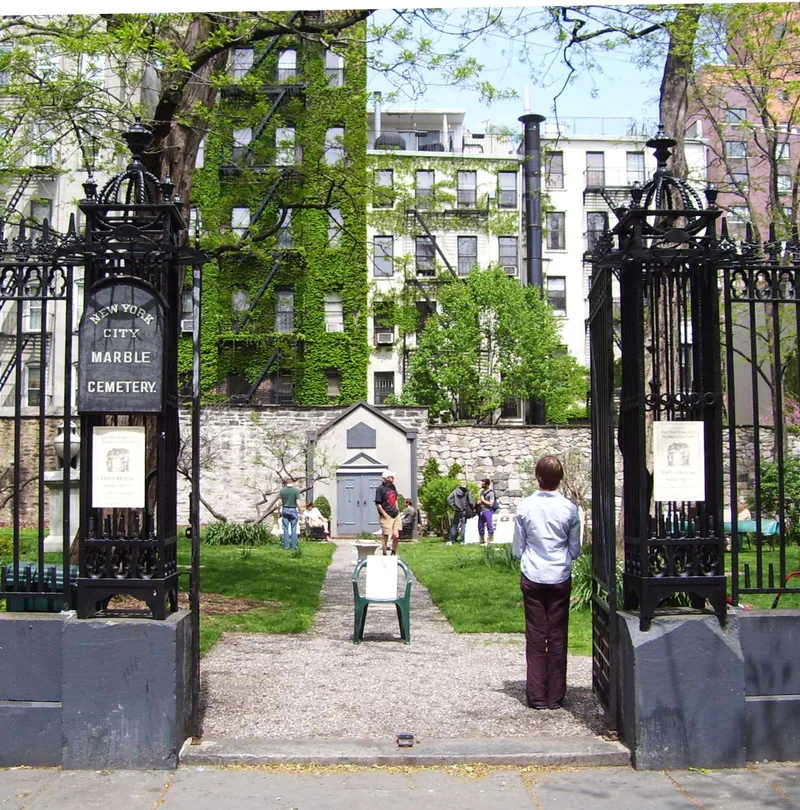
On East 2nd Street between First and Second Avenues, a walled burial ground sits among Lower East Side tenements. Begun in 1831, it was the second non-sectarian cemetery in New York City open to the public, laid out after an 1830 ordinance banned burials below Canal Street. Four gravel walks and a crosswalk run between strips of sod marked by flat marble slabs that cover 254 underground vaults built of Tuckahoe marble, which gave the cemetery its name. An arrow-pattern iron fence from 1832 and a Greek Revival gate face the street, and a stone dead-house stands at the rear. Families were allowed to erect monuments, many in classical forms such as urns, columns and obelisks. Those interred include Stephen Allen, James Lenox, Isaac Varian, Preserved Fish, Marinus Willett, Moses Taylor and John Lloyd Stephens. President James Monroe was buried here in 1831 until his remains were moved to Virginia in 1858. Endowments now support the grounds.
Significance in brief: It was the second non-sectarian burial ground in New York City open to the public. Its vaults hold many distinguished New York and national families and figures, including ex-President James Monroe (until 1858), Stephen Allen, James Lenox, Moses Taylor and John Lloyd Stephens. The form notes the original fence and burial vaults remain.
Machine-generated summary. This summary was generated by a language model from the official nomination document and has not been reviewed line by line by an editor. It may contain errors. Check the source document before relying on any detail. Source: nomination document (PDF) · National Archives catalog entry. NRHP reference 80002703, listed September 17, 1980. Summary generated October 2026 (model claude-sonnet-5-5, prompt v1.0-2026-10-29, confidence medium).
Key facts
| Address | 52-74 E. 2nd St., New York |
|---|---|
| County | Manhattan |
| Listed | September 17, 1980 |
| Reference number | 80002703 |
| Resource type | Site |
| Architectural style | Greek Revival entrance gate and iron fence; monuments in classical forms (urns, columns, obelisks) |
| Areas of significance | Community Planning and Development, Exploration/Settlement |
| Level of significance | Local |
| Status (as stated in the nomination) | Listed as occupied, in fair condition, on its original site; supported by endowments administered by boards of trustees. |
| Acreage | 0.9 |
| Coordinates | 40.72466, -73.98932 (NPS GIS) |
What listing means for this property
Sites (archaeological sites, battlefields, landscapes) are often listed with a restricted address to protect them from looting or disturbance. Listing is honorary for private owners; federal undertakings on or near the site go through Section 106 review, and state laws may protect burials and artefacts regardless of listing.
General information, not legal or tax advice. Rules change; confirm with your State Historic Preservation Office or a qualified adviser.
Sources and further reading
- National Park Service, National Register of Historic Places database (snapshot May 2026), reference 80002703.
- Nomination form (PDF, National Archives) — catalog entry
- Wikipedia article (used for cross-checking only; text not reproduced here)
- Wikidata Q7013238
- This listing as JSON
Last updated October 2026. Found an error? See the editorial policy for how to report it.