Metropolitan Life Insurance Company
Also known as: Metropolitan Tower; Metropolitan Life Insurance Tower

Why it's listed
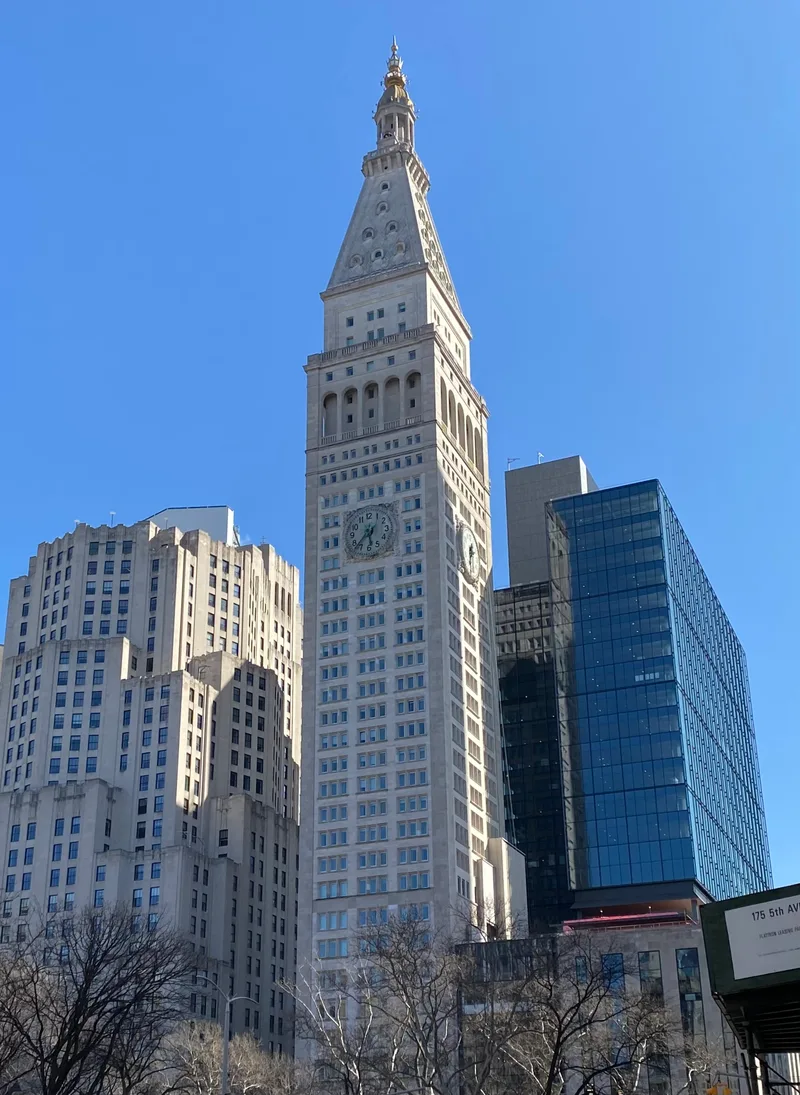
Rising 700 feet above Madison Square, this 50-story tower was completed in 1909 for the Metropolitan Life Insurance Company. Pierre and Michel Le Brun modeled it on the bell tower of St. Mark's in Venice, and it cost $6,581,391. It features four 26-foot clock dials, a beacon and four bells. Until the Woolworth Building opened in 1913, it was the tallest masonry and steel structure in the world. The company grew from a Civil War-era insurer into the world's largest life insurance firm by 1909, and it pioneered small-policy industrial insurance and social welfare programs. The tower became its emblem, appearing on hundreds of millions of policy documents. Early 1960s work replaced decaying marble with limestone, removed some ornament and balconies, and re-covered the cupola in aluminum, yet the form remained largely intact. Inside, the second-floor executive suite keeps its mahogany paneling and marble mantels. The nominated boundary covers only the tower.
Significance in brief: The tower is the symbol of Metropolitan Life, which the nomination presents as a leading example of the growth of the American life insurance industry. It is described as the most distinctive and least altered surviving Metropolitan building. Its construction coincided with the company's rise to first place in the industry, and it was the world's tallest masonry and steel structure until 1913.
Machine-generated summary. This summary was generated by a language model from the official nomination document and has not been reviewed line by line by an editor. It may contain errors. Check the source document before relying on any detail. Source: nomination document (PDF) · National Archives catalog entry. NRHP reference 78001874, listed June 2, 1978. Summary generated October 2026 (model claude-sonnet-5-5, prompt v1.0-2026-10-29, confidence medium).
Key facts
| Address | 1 Madison Ave., New York |
|---|---|
| County | Manhattan |
| Listed | June 2, 1978 |
| Reference number | 78001874 |
| Resource type | Building |
| Period of significance | 1909-present (1868+) |
| Architect / builder | Pierre & Michel Le Brun |
| Architectural style | Modeled on the campanile of St. Mark's in Venice; Renaissance detail, with the earlier main building described as Second Renaissance Revival |
| Areas of significance | Commerce |
| Level of significance | National |
| National Historic Landmark | Yes, designated June 2, 1978 |
| Status (as stated in the nomination) | Occupied and in use as an insurance company office; condition marked excellent and altered. The clock, bells and beacon still operate. |
| Acreage | 0.9 |
| Within district | Metropolitan Life Home Office Complex |
| Coordinates | 40.74128, -73.98736 (NPS GIS) |
What listing means for this property
For an income-producing building, listing (individually or as a contributing building in a district) is the gateway to the 20% federal rehabilitation tax credit on qualified rehabilitation costs, often stackable with state credits. Work claiming the credit must follow the Secretary of the Interior's Standards and be approved in advance.
Listing does not restrict a private owner acting without federal money or permits; where federal funding or licensing is involved, Section 106 review applies.
General information, not legal or tax advice. Rules change; confirm with your State Historic Preservation Office or a qualified adviser.
Sources and further reading
- National Park Service, National Register of Historic Places database (snapshot May 2026), reference 78001874.
- Nomination form (PDF, National Archives) — catalog entry
- Wikipedia article (used for cross-checking only; text not reproduced here)
- Wikidata Q652452
- This listing as JSON
Last updated October 2026. Found an error? See the editorial policy for how to report it.