Ellington, Edward Kennedy "Duke", House

Why it's listed
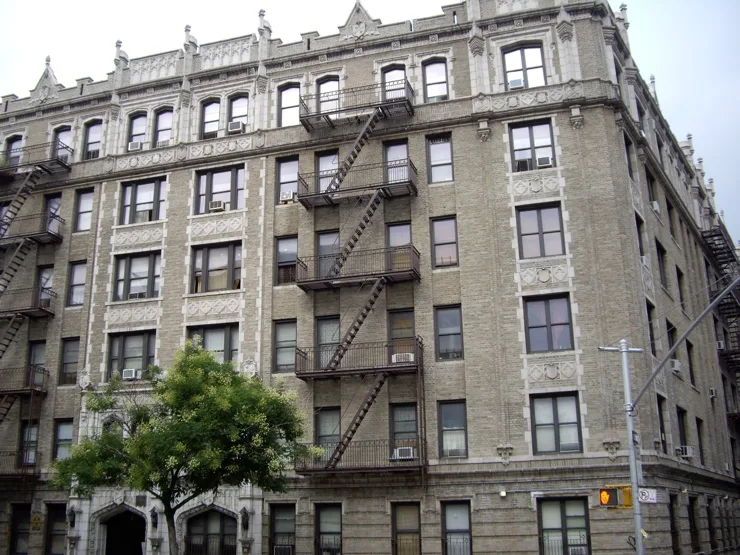
This six-story apartment building stands at the corner of St. Nicholas Avenue and W. 157th Street in Manhattan. It is best known as the home of composer and bandleader Duke Ellington, who moved into Apartment 4A in the late 1930s and early 1940s. The nomination credits Ellington with legitimizing jazz as a serious art form and with writing more than a thousand compositions for jazz groups, orchestras, theater, film, ballet and opera. Works the form associates with this period include "Ko-Ko," "Concerto for Cootie," "Harlem Air Shaft" and the extended piece "Black, Brown and Beige." The building itself is masonry, faced in brown brick, with limestone quatrefoil panels, stone turrets and pinnacles, and a stone-framed Gothic entrance bay. The form describes it as an excellent example of late Gothic Perpendicular style and a dominant presence at the north end of the avenue block. Its listing rests chiefly on the Ellington connection, within the context of Afro-American history and music.
Significance in brief: The nomination argues the building is significant for its link to Edward Kennedy "Duke" Ellington, one of America's most important composers and most influential jazz musicians. He moved into the building in the late 1930s and early 1940s, as he neared the height of his creativity. The form also treats the building as an excellent example of late Gothic Perpendicular style.
Machine-generated summary. This summary was generated by a language model from the official nomination document and has not been reviewed line by line by an editor. It may contain errors. Check the source document before relying on any detail. Source: nomination document (PDF) · National Archives catalog entry. NRHP reference 76001239, listed May 11, 1976. Summary generated October 2026 (model claude-sonnet-5-5, prompt v1.0-2026-10-29, confidence medium).
Key facts
| Address | 935 St. Nicholas Ave., Apt. 4A, New York |
|---|---|
| County | Manhattan |
| Listed | May 11, 1976 |
| Reference number | 76001239 |
| Resource type | Building |
| Period of significance | 1939-1961 |
| Architectural style | Late Gothic Perpendicular |
| Areas of significance | Black, Performing Arts |
| Level of significance | National |
| National Historic Landmark | Yes, designated May 11, 1976 |
| Status (as stated in the nomination) | Condition is given as fair on the form checkbox, though the text calls the building in good repair and well kept, needing minor exterior repair and brick cleaning and pointing. Listed as occupied, privately owned, in use as apartments. |
| Acreage | 0.9 |
| Within district | Dominican Historic District |
| Coordinates | 40.83235, -73.94138 (NPS GIS) |
What listing means for this property
National Register listing is honorary for a privately owned home: it does not by itself restrict what an owner may do with their own money, and it does not require public access. Restrictions come from local landmark or historic-district ordinances, which are separate (how they differ).
Owner-occupied houses are not eligible for the 20% federal rehabilitation tax credit, which applies to income-producing buildings, but many states offer credits for homeowners. Listing also opens the door to preservation easements and to buying a plaque. Start with what listing means for homeowners, renovating a listed house and selling one.
General information, not legal or tax advice. Rules change; confirm with your State Historic Preservation Office or a qualified adviser.
Sources and further reading
- National Park Service, National Register of Historic Places database (snapshot May 2026), reference 76001239.
- Nomination form (PDF, National Archives) — catalog entry
- Wikipedia article (used for cross-checking only; text not reproduced here)
- Wikidata Q2610027
- This listing as JSON
Last updated October 2026. Found an error? See the editorial policy for how to report it.