Civic Club
Also known as: Estonian House

Why it's listed
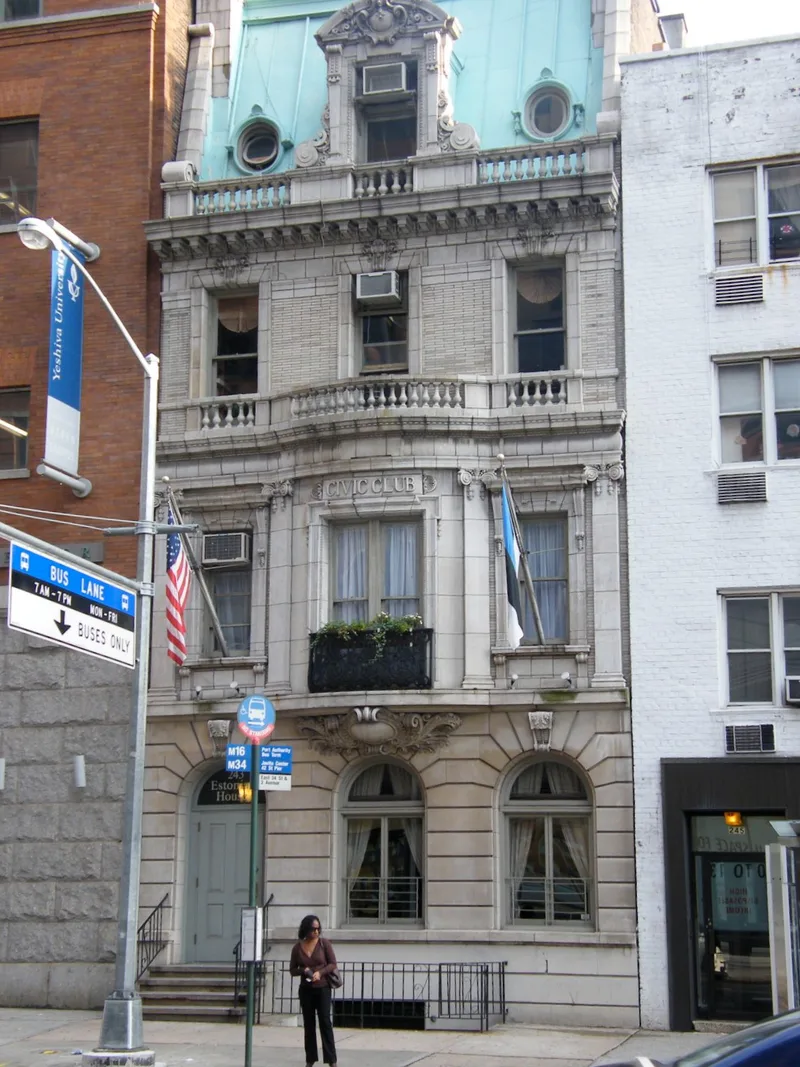
Erected in 1898-99 on a narrow lot in Manhattan's Murray Hill, this 3½-story limestone and brick building was designed by architect Thomas A. Gray for the Civic Club. Its three-bay facade combines a rusticated ground floor, grey Roman brick upper stories, a wrought-iron balcony, scroll keystones, a cartouche and a copper-sheathed mansard roof with an ornate dormer. Inside are a paneled entrance hall, staircase, inglenook and a domed oval meeting room. Frederick Norton Goddard, a social reformer and club president, commissioned it. The club offered personal service and money to needy residents of a district bounded by Fourth Avenue, 42nd Street, the East River and 23rd Street. The Goddard family kept the building until 1946, when it was sold to the Estonian Educational Society, founded in 1929. Now called Estonian House, it hosts senior, dance, singing and children's history programs. The building is valued as a Beaux-Arts design and for housing these two community organizations.
Significance in brief: The nomination argues it is an elegant example of French Beaux-Arts design and the home of two organizations reflecting New York's social and cultural development. It was built for the Civic Club, a charitable group aiding needy residents, and has since housed the Estonian Educational Society.
Machine-generated summary. This summary was generated by a language model from the official nomination document and has not been reviewed line by line by an editor. It may contain errors. Check the source document before relying on any detail. Source: nomination document (PDF) · National Archives catalog entry. NRHP reference 82003372, listed September 16, 1982. Summary generated October 2026 (model claude-sonnet-5-5, prompt v1.0-2026-10-29, confidence high).
Key facts
| Address | 243 E. 34th St., New York |
|---|---|
| County | Manhattan |
| Listed | September 16, 1982 |
| Reference number | 82003372 |
| Resource type | Building |
| Period of significance | 1898-99 |
| Architect / builder | Thomas A. Gray |
| Architectural style | French Beaux-Arts |
| Areas of significance | Architecture, Social History |
| Level of significance | Local |
| Status (as stated in the nomination) | Occupied; the exterior is largely unaltered except for replacement of the original cast-iron areaway fence. It now serves as Estonian House, home to several Estonian organizations. |
| Acreage | 0.9 |
| Coordinates | 40.74490, -73.97575 (NPS GIS) |
What listing means for this property
National Register listing is honorary: it recognises significance and does not restrict what a private owner may do without federal money or permits. It unlocks the 20% federal rehabilitation tax credit for income-producing buildings, state credits in many states, and Section 106 review when federal agencies are involved. See what listing means in practice.
General information, not legal or tax advice. Rules change; confirm with your State Historic Preservation Office or a qualified adviser.
Sources and further reading
- National Park Service, National Register of Historic Places database (snapshot May 2026), reference 82003372.
- Nomination form (PDF, National Archives) — catalog entry
- Wikipedia article (used for cross-checking only; text not reproduced here)
- Wikidata Q5124296
- This listing as JSON
Last updated October 2026. Found an error? See the editorial policy for how to report it.