Church of the Transfiguration and Rectory
Also known as: The Little Church Around the Corner

Why it's listed
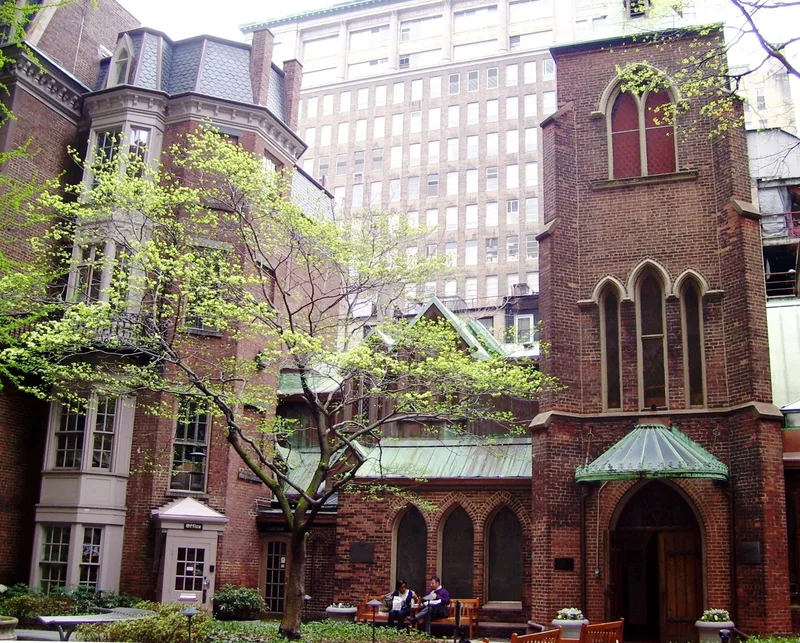
Tucked behind a fence and a quiet garden on East 29th Street in Manhattan, this small Gothic Revival church and its five-story rectory survive in the shadow of much taller buildings. The brick and brownstone church was completed in 1849 and grew through additions, including a tower and transept in 1854, a lich-gate given in 1896, and a Lady Chapel in 1906. The connected rectory, from about 1849-50, has a brownstone front, slate mansard roof and a five-sided tower-like wing. The church is best known as 'The Little Church Around the Corner,' a name dating from 1870 when actor Joseph Jefferson was directed there to arrange a friend's funeral. It became closely tied to the theatre, with memorial windows to leading actors, a window by John LaFarge, and the Episcopal Actors Guild headquartered there from 1923. It is also believed to have sheltered escaped slaves and given refuge during the 1863 Draft Riots.
Significance in brief: The church is picturesque, human-scaled and reminiscent of an English village church, and is long associated with the theatre as the 'actor's church.' It has been known since 1870 as 'The Little Church Around the Corner,' after actor Joseph Jefferson sought a funeral service for a friend. It is also thought to have served as a refuge for escaped slaves and Black New Yorkers during the Civil War and the 1863 Draft Riots.
Machine-generated summary. This summary was generated by a language model from the official nomination document and has not been reviewed line by line by an editor. It may contain errors. Check the source document before relying on any detail. Source: nomination document (PDF) · National Archives catalog entry. NRHP reference 73001216, listed June 4, 1973. Summary generated October 2026 (model claude-sonnet-5-5, prompt v1.0-2026-10-29, confidence high).
Key facts
| Address | 1 E. 29th St., New York |
|---|---|
| County | Manhattan |
| Listed | June 4, 1973 |
| Reference number | 73001216 |
| Resource type | Building |
| Period of significance | 19th Century |
| Architect / builder | Frederick C. Withers (architect of the lich-gate); rectory architect unknown |
| Architectural style | Gothic Revival |
| Areas of significance | Architecture, Performing Arts |
| Level of significance | State |
| Status (as stated in the nomination) | Condition is listed as excellent and altered; the church is in religious use and the property is occupied. |
| Acreage | 0.9 |
| Coordinates | 40.74553, -73.98688 (NPS GIS) |
What listing means for this property
Religious properties are listed for their architectural or historical significance, not their religious use. Listing is honorary and does not restrict the congregation's use of the building. The federal rehabilitation credit is generally unavailable unless part of the building is income-producing; some state programmes and preservation grants do cover religious buildings. Federal funding or permits trigger Section 106 review.
General information, not legal or tax advice. Rules change; confirm with your State Historic Preservation Office or a qualified adviser.
Sources and further reading
- National Park Service, National Register of Historic Places database (snapshot May 2026), reference 73001216.
- Nomination form (PDF, National Archives) — catalog entry
- Wikipedia article (used for cross-checking only; text not reproduced here)
- Wikidata Q431339
- This listing as JSON
Last updated October 2026. Found an error? See the editorial policy for how to report it.