Ganoung Cobblestone Farmhouse

Why it's listed
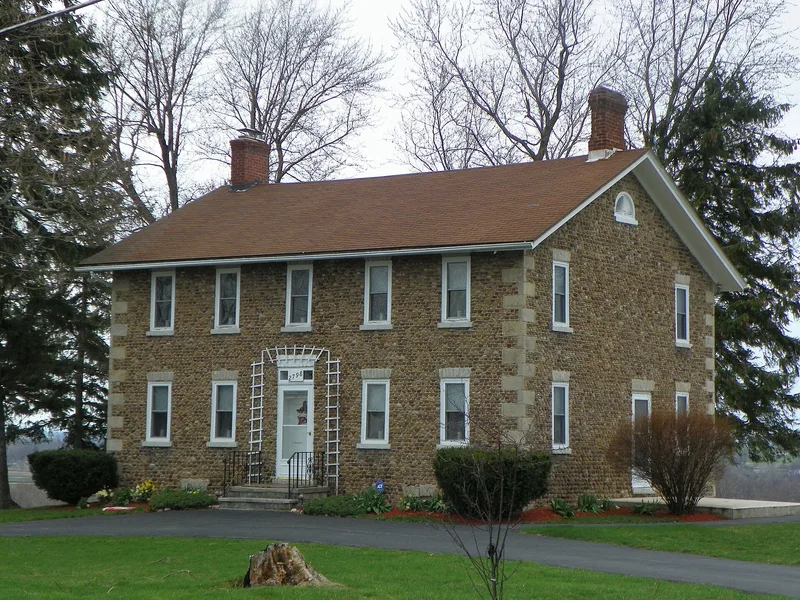
Cobblestone walls of varied fieldstones, laid in fine horizontal rows, form this two-story, five-bay farmhouse on Poplar Hill Road near South Lima in the town of Lima. Presumed to date from the early to mid-1830s, it has a gable roof parallel to the road, cut limestone quoins, sills and lintels, brick interior end chimneys, a central entry and a center hall flanked by parlors. These features reflect late Federal and early Greek Revival styles. The house is similar to the Morgan and Markham cobblestone farmhouses, though larger. A carriage barn, a shed and a well with pump from the nineteenth century also survive on the 94.6-acre farm. The Ganoung family occupied the farm from 1853 to 1937. In the nineteenth century it was known for sheep raising, with about 300 sheep sheared in 1865 and 1875, and for butter production. Drained swamplands later produced onions and cabbage. The property is valued for its architecture and its agricultural history.
Significance in brief: The nomination argues it is a distinctive example of early-phase cobblestone architecture in western New York, with late Federal and early Greek Revival features. Its significance is also tied to three surviving nineteenth-century support structures and part of the original farm, which was known locally for sheep raising and later muckland produce farming.
Machine-generated summary. This summary was generated by a language model from the official nomination document and has not been reviewed line by line by an editor. It may contain errors. Check the source document before relying on any detail. Source: nomination document (PDF) · National Archives catalog entry. NRHP reference 89001120, listed August 31, 1989. Summary generated October 2026 (model claude-sonnet-5-5, prompt v1.0-2026-10-29, confidence high).
Key facts
| Address | 2798 Popular Hill Rd., Lima |
|---|---|
| County | Livingston County |
| Listed | August 31, 1989 |
| Reference number | 89001120 |
| Resource type | Building |
| Period of significance | ca. 1830s - ca. 1900 |
| Architectural style | Vernacular with late Federal/early Greek Revival style design features |
| Criteria |
|
| Areas of significance | Agriculture, Architecture |
| Level of significance | Local |
| Status (as stated in the nomination) | Privately owned and used as a residence; condition listed as good; no threats known. |
| Acreage | 94.6 |
| Coordinates | 42.86442, -77.66137 (NPS GIS) |
What listing means for this property
National Register listing is honorary: it recognises significance and does not restrict what a private owner may do without federal money or permits. It unlocks the 20% federal rehabilitation tax credit for income-producing buildings, state credits in many states, and Section 106 review when federal agencies are involved. See what listing means in practice.
General information, not legal or tax advice. Rules change; confirm with your State Historic Preservation Office or a qualified adviser.
Sources and further reading
- National Park Service, National Register of Historic Places database (snapshot May 2026), reference 89001120.
- Nomination form (PDF, National Archives) — catalog entry
- Wikipedia article (used for cross-checking only; text not reproduced here)
- Wikidata Q5521470
- This listing as JSON
Last updated October 2026. Found an error? See the editorial policy for how to report it.