Haxton-Griffin Farm
Also known as: The Woodburner; Wagner Farm
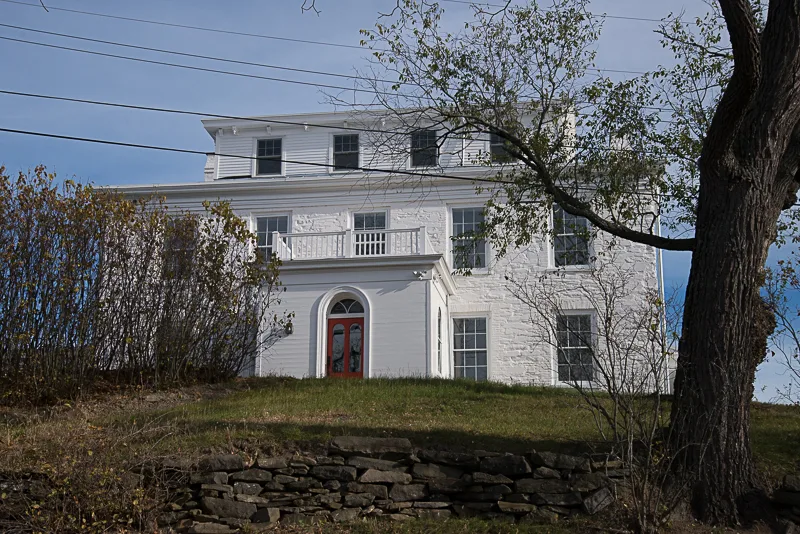

Why it's listed
Southwest of the village of Athens in Greene County, this farm of about 65 acres preserves the remnant of a late eighteenth-century holding that once exceeded 300 acres. Its centerpiece is a two-story stone house built around 1812 for Benjamin Haxton, with mortared rubble walls, a hipped roof and Federal-style features. Later owners left their marks: black marble mantels and a circular staircase reflect Greek Revival and Italianate tastes, and the roof was raised around 1880 when the house became a seasonal boarding house called The Woodburne. The Wagner family farmed the land and ran the guest business from 1921 onward. The property also includes a mid-nineteenth-century timber-frame barn, a c. 1900 bank barn and a c. 1930 frame farmhouse. After years of alteration and neglect, the house is being restored. The farm illustrates changing fortunes in Hudson Valley agriculture and the rise of Catskill summer tourism.
Significance in brief: The nomination argues the property is significant for architecture, agriculture and social history. The stone house shows Federal origins with later Greek Revival and Italianate changes. The farm also reflects the decline of regional farming and the shift to seasonal boarding-house use in the late nineteenth and early twentieth centuries.
Machine-generated summary. This summary was generated by a language model from the official nomination document and has not been reviewed line by line by an editor. It may contain errors. Check the source document before relying on any detail. Source: nomination document (PDF) · National Archives catalog entry. NRHP reference 11000999, listed January 4, 2012. Summary generated October 2026 (model claude-sonnet-5-5, prompt v1.0-2026-10-29, confidence medium).
Key facts
| Address | 84 Howard Hall Rd., Athens |
|---|---|
| County | Greene County |
| Listed | January 4, 2012 |
| Reference number | 11000999 |
| Resource type | Building |
| Period of significance | c. 1812-c. 1934 |
| Architectural style | Early Republic: Federal; Mid-19th Century: Greek Revival, Italianate |
| Criteria |
|
| Areas of significance | Architecture, Agriculture, Social History |
| Level of significance | Local |
| Status (as stated in the nomination) | The stone house fell into severe disrepair in the late twentieth century and is being restored. The surrounding land is still worked as a beef farm. |
| Acreage | 65.2 |
| Coordinates | 42.25967, -73.83983 (NPS GIS) |
What listing means for this property
National Register listing is honorary for a privately owned home: it does not by itself restrict what an owner may do with their own money, and it does not require public access. Restrictions come from local landmark or historic-district ordinances, which are separate (how they differ).
Owner-occupied houses are not eligible for the 20% federal rehabilitation tax credit, which applies to income-producing buildings, but many states offer credits for homeowners. Listing also opens the door to preservation easements and to buying a plaque. Start with what listing means for homeowners, renovating a listed house and selling one.
General information, not legal or tax advice. Rules change; confirm with your State Historic Preservation Office or a qualified adviser.
Sources and further reading
- National Park Service, National Register of Historic Places database (snapshot May 2026), reference 11000999.
- Nomination form (PDF, National Archives) — catalog entry
- Wikidata Q137212035
- This listing as JSON
Last updated October 2026. Found an error? See the editorial policy for how to report it.