Roosevelt, Theodore, Inaugural National Historic Site
Also known as: Wilcox,Ansley,House

Why it's listed
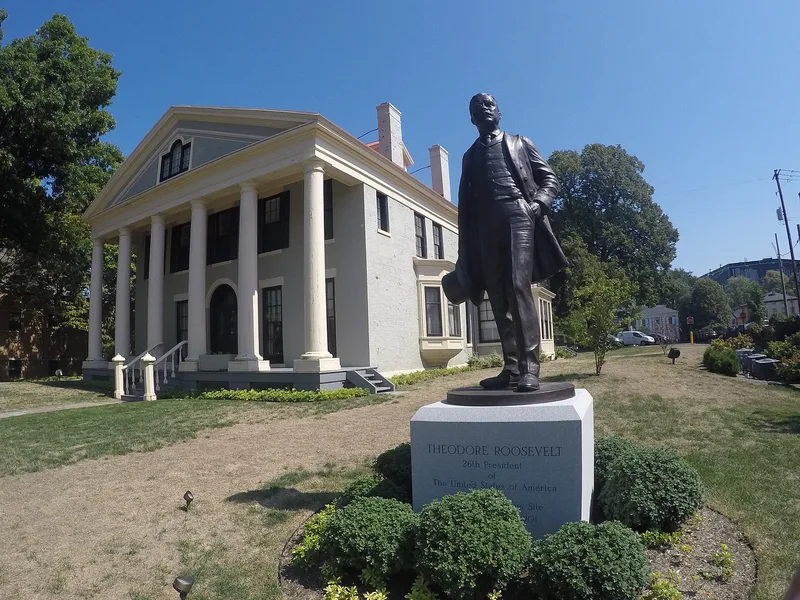
Located on Delaware Avenue in Buffalo, this two-and-a-half-story brick house began as an officers' quarters at a military garrison built in 1838. After the post was abandoned in 1845, the building passed into private hands. Albert Lanning moved its portico to the Delaware Avenue side in 1863. In the 1890s lawyer Ansley Wilcox hired Buffalo architect George Cary to roughly triple its size, producing a stately Greek Revival mansion. On September 14, 1901, Theodore Roosevelt was sworn in as the twenty-sixth President in the house's library, in front of McKinley's Cabinet members, after President McKinley died following his shooting at the Pan-American Exposition. Roosevelt was a close friend of Wilcox. The house later served as a restaurant before local citizens saved it from demolition in the 1960s. Restored from 1970, it now includes a museum on the first floor and is among the few inaugural sites outside Washington.
Significance in brief: On September 14, 1901, Theodore Roosevelt took the presidential oath of office in the library of this house, following President McKinley's death after the Pan-American Exposition shooting. It is one of few inaugural sites outside Washington. It is also one of the oldest houses in Buffalo, with local historical and architectural importance.
Machine-generated summary. This summary was generated by a language model from the official nomination document and has not been reviewed line by line by an editor. It may contain errors. Check the source document before relying on any detail. Source: nomination document (PDF) · National Archives catalog entry. NRHP reference 66000516, listed November 2, 1966. Summary generated October 2026 (model claude-sonnet-5-5, prompt v1.0-2026-10-29, confidence high).
Key facts
| Address | 641 Delaware Ave., Buffalo |
|---|---|
| County | Erie County |
| Listed | November 2, 1966 |
| Reference number | 66000516 |
| Resource type | Building |
| Period of significance | 1900- |
| Architect / builder | U.S. Army/George Cary |
| Architectural style | Greek Revival |
| Areas of significance | Politics/Government |
| Level of significance | National |
| Status (as stated in the nomination) | Restored beginning in 1970; the front first floor operates as a historic house museum with visitor reception and exhibit space, and the rear portion is leased as an office. Condition listed as excellent. |
| Acreage | 1 |
| Coordinates | 42.90155, -78.86079 (NPS GIS) |
What listing means for this property
National Register listing is honorary: it recognises significance and does not restrict what a private owner may do without federal money or permits. It unlocks the 20% federal rehabilitation tax credit for income-producing buildings, state credits in many states, and Section 106 review when federal agencies are involved. See what listing means in practice.
General information, not legal or tax advice. Rules change; confirm with your State Historic Preservation Office or a qualified adviser.
Sources and further reading
- National Park Service, National Register of Historic Places database (snapshot May 2026), reference 66000516.
- Nomination form (PDF, National Archives) — catalog entry
- Wikipedia article (used for cross-checking only; text not reproduced here)
- Wikidata Q7782001
- This listing as JSON
Last updated October 2026. Found an error? See the editorial policy for how to report it.