Chapel of Our Lady Help of Christians
Also known as: Maria Hilf Chapel

Why it's listed
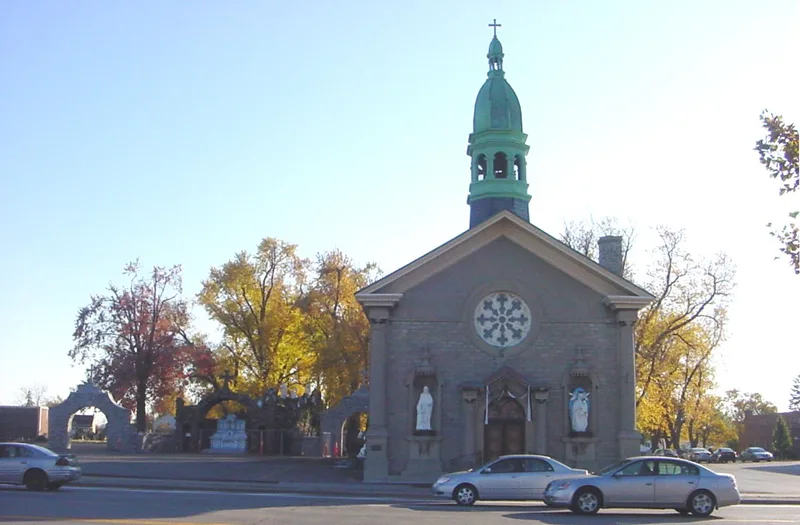
Maria Hilf Chapel, on a limestone ridge in Cheektowaga about seven miles east of downtown Buffalo, began in 1853 as a small brick sanctuary built by Alsatian immigrant Joseph Batt. He had vowed in 1836, during a North Atlantic hurricane at sea, to honor Our Lady Help of Christians. A limestone nave followed in 1871, and the rear nave and the classical west front were added in 1926. The plain exterior blended with the Greek Revival churches of the period, while the interior, with round arch windows, a barrel vaulted ceiling, frescos and stained glass, recalled an Alsatian village church. A pilgrimage began once the chapel was finished and continued for more than a century. Statues, windows, a Lourdes Grotto and a Kreuzberg shrine record use by Polish, Italian, Irish, Hungarian and German worshippers. The chapel is also one of the few remaining landmarks of a rural township that became a Buffalo suburb.
Significance in brief: The chapel is tied to the European immigration of the 19th century, especially the Alsatian settlement in western New York, and to the Maria Hilf Pilgrimage that began with its completion. Its architecture contrasts a plain American exterior with an Alsatian-style interior. Later additions and decoration show its use by Polish, Italian, Irish, German and other immigrant groups.
Machine-generated summary. This summary was generated by a language model from the official nomination document and has not been reviewed line by line by an editor. It may contain errors. Check the source document before relying on any detail. Source: nomination document (PDF) · National Archives catalog entry. NRHP reference 78001851, listed December 14, 1978. Summary generated October 2026 (model claude-sonnet-5-5, prompt v1.0-2026-10-29, confidence medium).
Key facts
| Address | 4125 Union Rd., Cheektowaga |
|---|---|
| County | Erie County |
| Listed | December 14, 1978 |
| Reference number | 78001851 |
| Resource type | Building |
| Period of significance | 1800-1899, 1900- (specific dates 1853, 1871, 1926) |
| Architect / builder | Joseph Batt (1853); Foit and Baschnagel, architectural firm (1926); George Kempf and Sons, Buffalo (builder) |
| Areas of significance | Exploration/Settlement, Architecture |
| Level of significance | Local |
| Status (as stated in the nomination) | Listed as occupied, in use for religious purposes; condition marked good. Later sacristies on the east and south walls no longer serve a useful function. |
| Acreage | 0.9 |
| Coordinates | 42.92606, -78.75370 (NPS GIS) |
What listing means for this property
Religious properties are listed for their architectural or historical significance, not their religious use. Listing is honorary and does not restrict the congregation's use of the building. The federal rehabilitation credit is generally unavailable unless part of the building is income-producing; some state programmes and preservation grants do cover religious buildings. Federal funding or permits trigger Section 106 review.
General information, not legal or tax advice. Rules change; confirm with your State Historic Preservation Office or a qualified adviser.
Sources and further reading
- National Park Service, National Register of Historic Places database (snapshot May 2026), reference 78001851.
- Nomination form (PDF, National Archives) — catalog entry
- Wikipedia article (used for cross-checking only; text not reproduced here)
- Wikidata Q7110719
- This listing as JSON
Last updated October 2026. Found an error? See the editorial policy for how to report it.