American Grain Complex (Additional Documentation)
Also known as: Perot Malthouse; Perot Elevator

Why it's listed
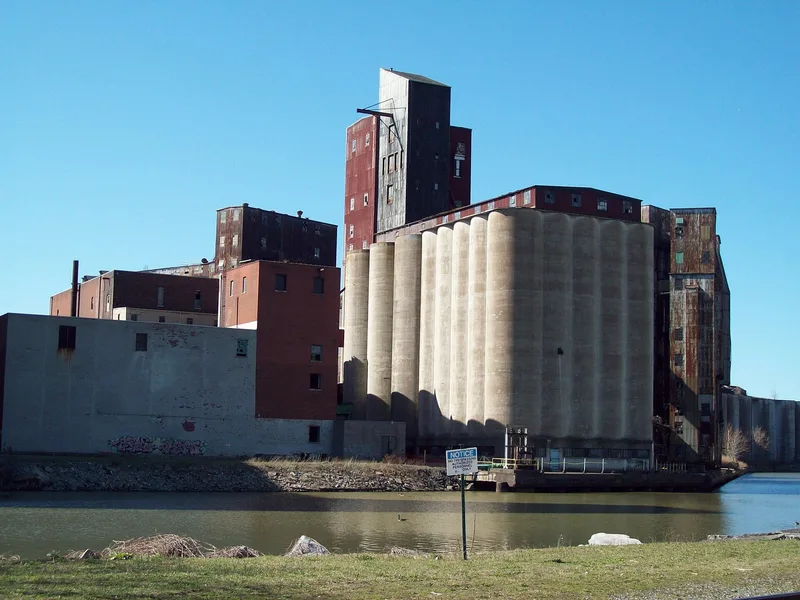
Beside the Buffalo River on Childs Street, this industrial complex combines a concrete grain elevator, a flour mill and warehouse, an office building, a movable marine tower and a network of rail tracks. Construction came in phases: the elevator and malt house in 1905-1906 for the American Malting Company, a flour mill in 1924, and a large storage annex in 1931. The site first made malt for brewers, then switched to flour after Prohibition, later operating under Russell-Miller and Peavey and finally ConAgra until 2001. It is considered important for its role in moving Midwestern grain east by lake, rail and road. Its engineering firsts include the earliest national use of continuous slip-form concrete pouring in an elevator, the oldest surviving marine receiving equipment on the Buffalo waterfront, and a 1963 pneumatic system that made it the largest pneumatic mill in the country. The buildings are currently not in use.
Significance in brief: The complex is argued to be significant under Criterion A in industry, engineering and architecture as an intact record of Buffalo's grain transshipment, malting and flour milling. It includes the oldest surviving marine receiving equipment on the Buffalo waterfront and the first national example of continuous slip form concrete pour for an elevator. A 1963 pneumatic system made it the nation's largest pneumatic mill. It is also eligible under Criterion C for design that influenced pioneer modernist writers.
Machine-generated summary. This summary was generated by a language model from the official nomination document and has not been reviewed line by line by an editor. It may contain errors. Check the source document before relying on any detail. Source: nomination document (PDF) · National Archives catalog entry. NRHP reference 12000475, listed August 7, 2012. Summary generated October 2026 (model claude-sonnet-5-5, prompt v1.0-2026-10-29, confidence high).
Key facts
| Address | 100 Childs St. aka 145 Buffalo River, Buffalo |
|---|---|
| County | Erie County |
| Listed | August 7, 2012 |
| Reference number | 12000475 |
| Resource type | Building |
| Period of significance | 1905-1963 |
| Architect / builder | James Stewart & Company (mainhouse and fixed marine tower); J. W. Cowper of Boston (1924 flour mill); Monarch Engineering to the in-house design of H.R. Wait (1931 annex) |
| Architectural style | No Style; Early 20th Century American commercial |
| Criteria |
|
| Areas of significance | Architecture, Engineering, Industry |
| Level of significance | Local |
| Status (as stated in the nomination) | Flour production ended in 2001 when ConAgra abandoned the facility; it was purchased around 2006 and is currently not in use. |
| Acreage | 3.24 |
| Coordinates | 42.86401, -78.86396 (NPS GIS) |
What listing means for this property
National Register listing is honorary: it recognises significance and does not restrict what a private owner may do without federal money or permits. It unlocks the 20% federal rehabilitation tax credit for income-producing buildings, state credits in many states, and Section 106 review when federal agencies are involved. See what listing means in practice.
Noted as vacant in the nomination. Nomination documents can be decades old; current status may differ. If you are considering buying an empty listed property, read the due-diligence checklist.
General information, not legal or tax advice. Rules change; confirm with your State Historic Preservation Office or a qualified adviser.
Sources and further reading
- National Park Service, National Register of Historic Places database (snapshot May 2026), reference 12000475.
- Nomination form (PDF, National Archives) — catalog entry
- Wikipedia article (used for cross-checking only; text not reproduced here)
- Wikidata Q14706157
- This listing as JSON
Last updated October 2026. Found an error? See the editorial policy for how to report it.