Sterling Grist Mill Complex
Also known as: Sterling Center

Why it's listed
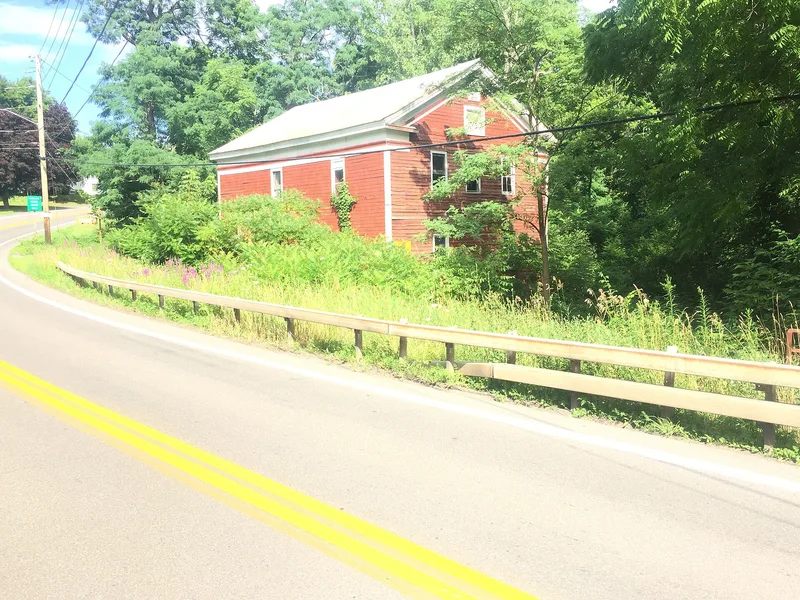
Beside Sterling Creek in the hamlet of Sterling Center, this one-acre site holds a two-and-one-half-story timber-frame grist mill built around 1835, along with a dam, a riveted metal penstock added about 1900, and the foundation ruins of an 1859 tannery. The mill probably replaced an 1813 mill built for Edwin Clark. It has a stone foundation, clapboard siding, and Greek Revival touches such as a wide frieze band and cornice returns. Inside, gears and pulleys from the 1830s survive, and the turbine is reported to lie buried in silt. The complex was listed for its role in the settlement and agricultural economy of northern Cayuga County, where the creek's waterpower supported milling, sawing, and tanning. It also represents heavy timber mill construction, once common in rural New York. The building is vacant and deteriorating, and runoff erosion threatens it. The tannery ruins were not counted as contributing because little is known about them.
Significance in brief: The complex is argued to be significant under Criterion A for its link to the settlement and early growth of northern Cayuga County, and as the earliest water-powered industrial site in Sterling Center. Under Criterion C, the mill is a representative example of heavy timber-frame mill construction with Greek Revival detailing and surviving circa 1835 mechanical parts.
Machine-generated summary. This summary was generated by a language model from the official nomination document and has not been reviewed line by line by an editor. It may contain errors. Check the source document before relying on any detail. Source: nomination document (PDF) · National Archives catalog entry. NRHP reference 01001498, listed January 24, 2002. Summary generated October 2026 (model claude-sonnet-5-5, prompt v1.0-2026-10-29, confidence high).
Key facts
| Address | 1332 NY 104A, Sterling |
|---|---|
| County | Cayuga County |
| Listed | January 24, 2002 |
| Reference number | 01001498 |
| Resource type | Building |
| Period of significance | circa 1813- circa 1900 |
| Architect / builder | Unknown |
| Architectural style | Mid-nineteenth century: Greek Revival |
| Criteria |
|
| Areas of significance | Architecture, Exploration/Settlement, Industry |
| Level of significance | Local |
| Status (as stated in the nomination) | Current function listed as vacant; the mill is in disrepair after extended neglect and is not in operating order. The center of the dam is breached. |
| Acreage | 0.9 |
| Coordinates | 43.32525, -76.64674 (NPS GIS) |
What listing means for this property
For an income-producing building, listing (individually or as a contributing building in a district) is the gateway to the 20% federal rehabilitation tax credit on qualified rehabilitation costs, often stackable with state credits. Work claiming the credit must follow the Secretary of the Interior's Standards and be approved in advance.
Listing does not restrict a private owner acting without federal money or permits; where federal funding or licensing is involved, Section 106 review applies.
Noted as vacant in the nomination. Nomination documents can be decades old; current status may differ. If you are considering buying an empty listed property, read the due-diligence checklist.
General information, not legal or tax advice. Rules change; confirm with your State Historic Preservation Office or a qualified adviser.
Sources and further reading
- National Park Service, National Register of Historic Places database (snapshot May 2026), reference 01001498.
- Nomination form (PDF, National Archives) — catalog entry
- Wikipedia article (used for cross-checking only; text not reproduced here)
- Wikidata Q7611409
- This listing as JSON
Last updated October 2026. Found an error? See the editorial policy for how to report it.