Sherwood Equal Rights Historic District

Why it's listed
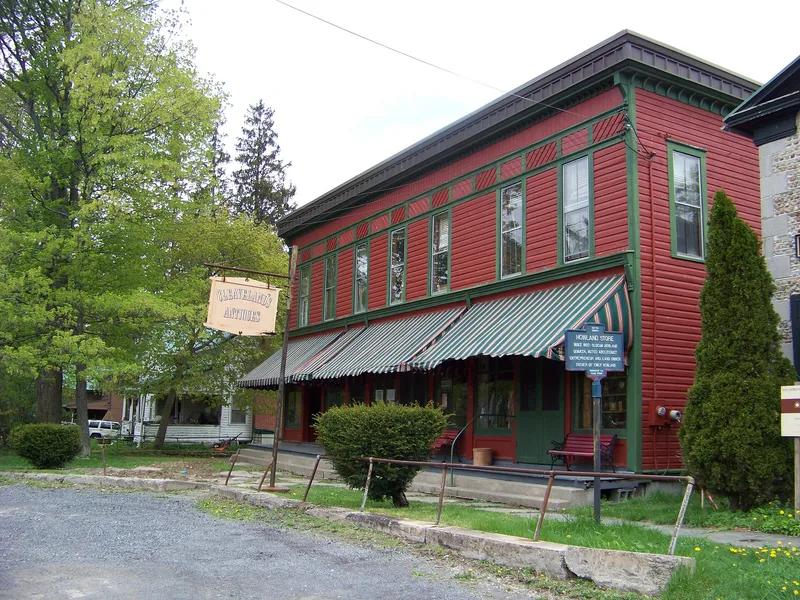
Sherwood is a small crossroads hamlet in the town of Scipio, Cayuga County, where nearly every building along Sherwood Road and Route 34B survives from the 19th and early 20th centuries. Most are modest frame houses in vernacular Federal, Greek Revival and Victorian styles. Landmarks include the 1837 Howland Cobblestone Store, now a museum, the 1883 Howland Commercial Block, the former Sherwood House inn, a ca. 1905 grange hall, an 1851 schoolhouse and a one-acre cemetery. The district matters because of the people who lived here. Quaker families, above all the Howlands, supported abolition, women's rights and education. Emily Howland taught in schools for free people of color, helped lead suffrage organizations and founded the Sherwood Select School. Her home received visitors including Harriet Tubman, Booker T. Washington, Sojourner Truth and Susan B. Anthony. Nearby rural properties linked to the same themes were left out because they had lost integrity. Several key buildings are vacant and deteriorating.
Significance in brief: The hamlet retains a large, intact group of buildings tied to Quaker families who advocated abolitionism, women's rights, education and social equality. The Howland family, especially Emily Howland, was central to these movements. Houses here sheltered African Americans and hosted figures such as Harriet Tubman, Susan B. Anthony and Sojourner Truth.
Machine-generated summary. This summary was generated by a language model from the official nomination document and has not been reviewed line by line by an editor. It may contain errors. Check the source document before relying on any detail. Source: nomination document (PDF) · National Archives catalog entry. NRHP reference 08000096, listed February 29, 2008. Summary generated October 2026 (model claude-sonnet-5-5, prompt v1.0-2026-10-29, confidence medium).
Key facts
| Address | Sherwood Rd. & NY 34B, Sherwood |
|---|---|
| County | Cayuga County |
| Listed | February 29, 2008 |
| Reference number | 08000096 |
| Resource type | District |
| Architect / builder | Slocum Howland (cobblestone store, 1837); William Howland (Howland Commercial Block, 1883) |
| Architectural style | Federal, Greek Revival, Victorian (Italianate, Stick Style, Gothic), and vernacular interpretations |
| Areas of significance | Social History, Black, Other, Architecture |
| Level of significance | State |
| Status (as stated in the nomination) | Several resources are described as vacant and deteriorated, including the Thomas-Brown House, Opendore, the Slocum and Hannah Howland House and the Grange Hall. The Howland Cobblestone Store is now a museum and other buildings remain private homes. |
| Acreage | 30 |
| Coordinates | 42.76239, -76.62040 (NPS GIS) |
What listing means for this property
This is a historic district. Buildings within its boundary are either contributing (they add to the district's significance) or non-contributing. Owners of contributing income-producing buildings can claim the 20% federal rehabilitation tax credit; homeowners should look at state credits. National Register districts impose no design review by themselves; a local historic district ordinance, if one exists, does (the difference explained).
General information, not legal or tax advice. Rules change; confirm with your State Historic Preservation Office or a qualified adviser.
Sources and further reading
- National Park Service, National Register of Historic Places database (snapshot May 2026), reference 08000096.
- Nomination form (PDF, National Archives) — catalog entry
- Wikipedia article (used for cross-checking only; text not reproduced here)
- Wikidata Q7495518
- This listing as JSON
Last updated October 2026. Found an error? See the editorial policy for how to report it.