Mosher Farmstead
Also known as: Brightside Farms

Why it's listed
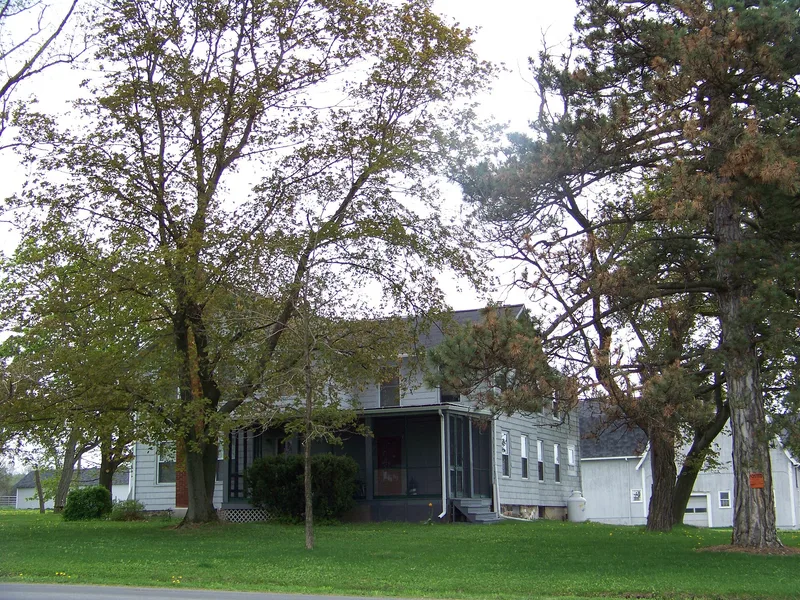
Mosher Farmstead is a 178.9-acre farm along Sherwood Road east of Aurora, in the town of Ledyard. Its buildings stand on the south side of the road: a late nineteenth century farmhouse, a tenant house, and seven agricultural buildings. The farm began around 1887, when E. W. Mosher bought a large farm. In 1907 he built a massive U-shaped, gambrel-roofed dairy barn and opened Brightside Farms, known for milk and cream from registered Jersey cattle. After a fire in 1921, his son R. E. Mosher rebuilt the complex to the original plans. Large-scale dairying ended with his death in 1923. The barn still holds original hay tracks, ventilation shafts, metal stanchions, water cups, cork-tile flooring and feed carts. A calf barn, bull barn, machine shed, shop and two chicken houses also survive. The property was listed for its intact agricultural architecture and its link to Finger Lakes dairy farming.
Significance in brief: It is a largely intact collection of late nineteenth and early twentieth century farm buildings, led by a very large U-shaped, gambrel-roofed dairy barn built in 1907 and rebuilt in 1921 after a fire. It is also tied to the dairy history of the Finger Lakes region through Brightside Farms, a locally known producer of Register of Merit Jersey dairy products. Criterion C covers the buildings, and Criterion A covers dairy farming.
Machine-generated summary. This summary was generated by a language model from the official nomination document and has not been reviewed line by line by an editor. It may contain errors. Check the source document before relying on any detail. Source: nomination document (PDF) · National Archives catalog entry. NRHP reference 03001280, listed December 12, 2003. Summary generated October 2026 (model claude-sonnet-5-5, prompt v1.0-2026-10-29, confidence high).
Key facts
| Address | 1016 Sherwood Rd., Aurora |
|---|---|
| County | Cayuga County |
| Listed | December 12, 2003 |
| Reference number | 03001280 |
| Resource type | District |
| Period of significance | 1880s - ca. 1921 |
| Architectural style | Late 19th/early 20th century: vernacular |
| Criteria |
|
| Areas of significance | Agriculture, Architecture |
| Level of significance | Local |
| Status (as stated in the nomination) | Still in agricultural use; the farm remains in the Mosher family, and large-scale dairying ended in the early 1920s. The farmhouse has been altered but retains its form, and the tenant house has lost integrity through extensive alterations. |
| Acreage | 178.9 |
| Coordinates | 42.75765, -76.67204 (NPS GIS) |
What listing means for this property
This is a historic district. Buildings within its boundary are either contributing (they add to the district's significance) or non-contributing. Owners of contributing income-producing buildings can claim the 20% federal rehabilitation tax credit; homeowners should look at state credits. National Register districts impose no design review by themselves; a local historic district ordinance, if one exists, does (the difference explained).
General information, not legal or tax advice. Rules change; confirm with your State Historic Preservation Office or a qualified adviser.
Sources and further reading
- National Park Service, National Register of Historic Places database (snapshot May 2026), reference 03001280.
- Nomination form (PDF, National Archives) — catalog entry
- Wikipedia article (used for cross-checking only; text not reproduced here)
- Wikidata Q6916204
- This listing as JSON
Last updated October 2026. Found an error? See the editorial policy for how to report it.