Aurora Steam Grist Mill

Why it's listed
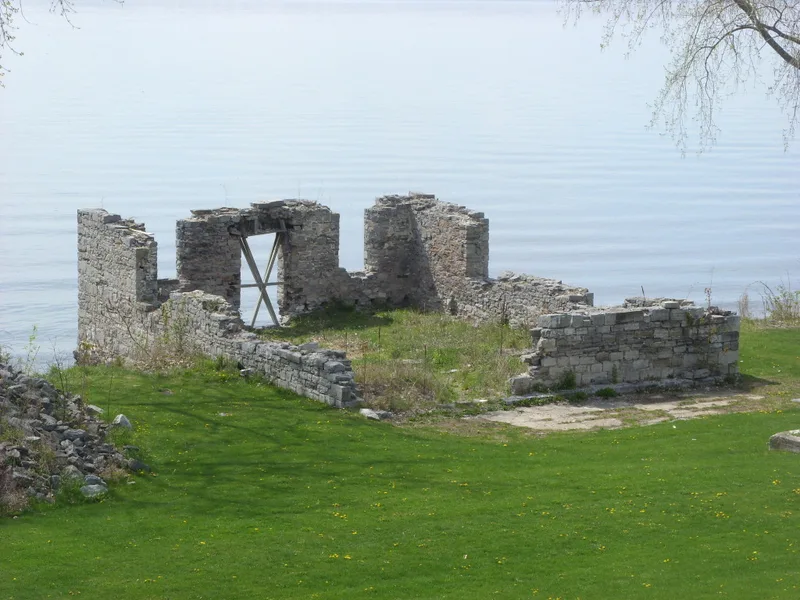
Built in 1817 on the shore of Cayuga Lake, this three-and-one-half-story stone mill was commissioned by Roswell Tousley, a blacksmith and inventor who settled in Aurora in 1806. Junia Curtis is credited with building it and designing its steam engine. The mill is believed to be among the first steam-powered mills west of the Hudson River, and local residents viewed it with skepticism. Tousley could not pay the construction and machinery costs, and the engine was removed in 1819. By 1832 the building belonged to the Morgan family. Edwin B. Morgan had the lake dredged so canal boats and steamers could dock beside it, and used it to store grain bound for New York City. Morgan later became first president of Wells Fargo, co-founder of American Express, and a supporter of Wells College. The building survived an 1838 storm that destroyed other lakefront structures. Wells College bought it in 1944, and it has stood unused since then. Its roof partially collapsed in 1974, but the walls remain sound.
Significance in brief: The mill is considered a typical example of early mill architecture in upstate New York and is believed to be one of the first steam-powered mills west of the Hudson River. It worked briefly as a mill before Tousley's finances collapsed. It later served as a grain warehouse and shipping point for merchant Edwin B. Morgan, who became a prominent businessman and philanthropist.
Machine-generated summary. This summary was generated by a language model from the official nomination document and has not been reviewed line by line by an editor. It may contain errors. Check the source document before relying on any detail. Source: nomination document (PDF) · National Archives catalog entry. NRHP reference 76001207, listed July 30, 1976. Summary generated October 2026 (model claude-sonnet-5-5, prompt v1.0-2026-10-29, confidence high).
Key facts
| Address | Main St., Aurora |
|---|---|
| County | Cayuga County |
| Listed | July 30, 1976 |
| Reference number | 76001207 |
| Resource type | Building |
| Period of significance | 1800-1899 |
| Architect / builder | Junia Curtis |
| Areas of significance | Industry, Commerce, Architecture |
| Level of significance | Local |
| Status (as stated in the nomination) | Unoccupied and unused since Wells College bought it in 1944; the roof partially collapsed in 1974, though the walls were described as sound and restoration plans were underway. |
| Acreage | 2 |
| Within district | Aurora Village-Wells College Historic District |
| Coordinates | 42.75423, -76.70384 (NPS GIS) |
What listing means for this property
For an income-producing building, listing (individually or as a contributing building in a district) is the gateway to the 20% federal rehabilitation tax credit on qualified rehabilitation costs, often stackable with state credits. Work claiming the credit must follow the Secretary of the Interior's Standards and be approved in advance.
Listing does not restrict a private owner acting without federal money or permits; where federal funding or licensing is involved, Section 106 review applies.
Noted as vacant in the nomination. Nomination documents can be decades old; current status may differ. If you are considering buying an empty listed property, read the due-diligence checklist.
General information, not legal or tax advice. Rules change; confirm with your State Historic Preservation Office or a qualified adviser.
Sources and further reading
- National Park Service, National Register of Historic Places database (snapshot May 2026), reference 76001207.
- Nomination form (PDF, National Archives) — catalog entry
- Wikipedia article (used for cross-checking only; text not reproduced here)
- Wikidata Q4822610
- This listing as JSON
Last updated October 2026. Found an error? See the editorial policy for how to report it.