Goodwill Theatre

Why it's listed
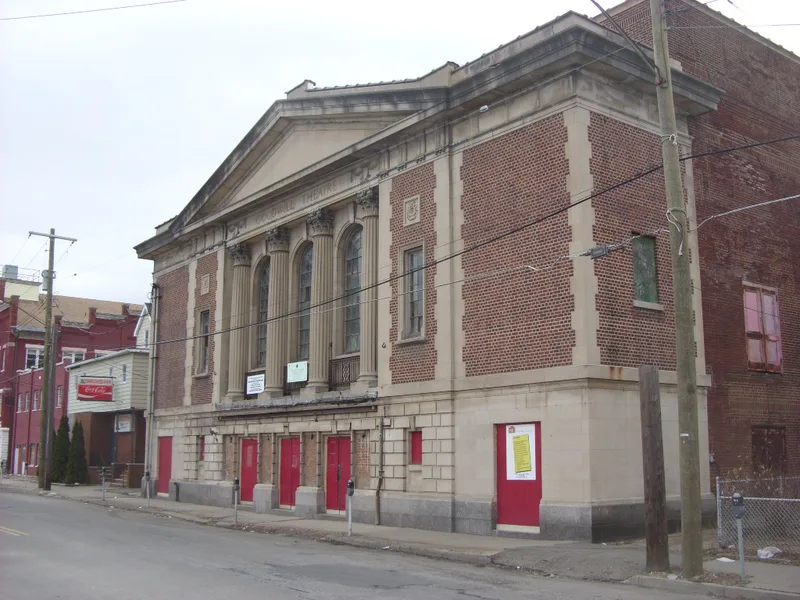
Goodwill Theatre, at 36 Willow Street in Johnson City, New York, is a three-story movie theater completed in 1920 to a Neoclassical design by the local firm Lacey, Schenck and Cummings. It has a steel and reinforced concrete frame faced in red brick, limestone and marble. The east facade centers on a temple form with four Composite columns and horseshoe-arched stained-glass windows. Inside, fluted columns flank the stage, and a blue barrel-vaulted ceiling holds a decorated central dome. George F. Johnson of the Endicott Johnson Shoe Company commissioned the theater for his workers and their families, at a reported cost of $354,497.63, and it opened on December 16, 1920. It reflects his recreation and welfare programs, including his campaign for Sunday movies. It hosted films, vaudeville, concerts and boxing matches. The seats have been removed and some plaster is damaged, yet the building keeps much of its integrity, and restoration of its decoration and colors was under way when it was nominated.
Significance in brief: The theater is significant under Criteria A and C as a distinctive early twentieth century Neoclassical movie theater with a monumental temple-form facade and classically inspired interior. It is also tied to the recreation programs of George F. Johnson of the Endicott Johnson Shoe Company, who gave it to the community's workers and their families as part of his welfare capitalism policies.
Machine-generated summary. This summary was generated by a language model from the official nomination document and has not been reviewed line by line by an editor. It may contain errors. Check the source document before relying on any detail. Source: nomination document (PDF) · National Archives catalog entry. NRHP reference 99001655, listed January 7, 2000. Summary generated October 2026 (model claude-sonnet-5-5, prompt v1.0-2026-10-29, confidence high).
Key facts
| Address | 36 Willow St., Johnson City |
|---|---|
| County | Broome County |
| Listed | January 7, 2000 |
| Reference number | 99001655 |
| Resource type | Building |
| Period of significance | 1920 |
| Architect / builder | Lacey, Schenck and Cummings |
| Architectural style | Late 19th & 20th Century Revivals (Neoclassical) |
| Criteria |
|
| Areas of significance | Social History, Entertainment/Recreation, Architecture |
| Level of significance | Local |
| Status (as stated in the nomination) | Listed as vacant; seats removed and plaster damaged, but the theater is described as being in the process of restoration. |
| Acreage | 0.9 |
| Coordinates | 42.11395, -75.95516 (NPS GIS) |
What listing means for this property
For an income-producing building, listing (individually or as a contributing building in a district) is the gateway to the 20% federal rehabilitation tax credit on qualified rehabilitation costs, often stackable with state credits. Work claiming the credit must follow the Secretary of the Interior's Standards and be approved in advance.
Listing does not restrict a private owner acting without federal money or permits; where federal funding or licensing is involved, Section 106 review applies.
Noted as vacant in the nomination. Nomination documents can be decades old; current status may differ. If you are considering buying an empty listed property, read the due-diligence checklist.
General information, not legal or tax advice. Rules change; confirm with your State Historic Preservation Office or a qualified adviser.
Sources and further reading
- National Park Service, National Register of Historic Places database (snapshot May 2026), reference 99001655.
- Nomination form (PDF, National Archives) — catalog entry
- Wikipedia article (used for cross-checking only; text not reproduced here)
- Wikidata Q5583660
- This listing as JSON
Last updated October 2026. Found an error? See the editorial policy for how to report it.