Endicott Square Deal Arch

Why it's listed
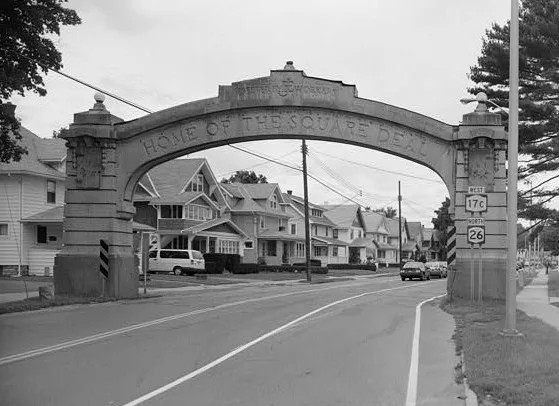
Spanning Main Street in Endicott, this arch was erected in 1920 as a gift from the workers of the Endicott-Johnson shoe company to their employer, George F. Johnson. It has a five-centered opening on tapering piers, with rusticated cast stone blocks over a steel frame, an entablature and swag decoration. Inscriptions mark it as the home of the Square Deal and a gateway to the Square Deal towns. It has a twin in Johnson City, and both were dedicated on 6 September 1920. Workers each gave $3 toward the cost, thanking Johnson for a new profit sharing plan. Arthur T. Lacey designed the arches, and the company's mechanical departments directed construction. The arch was listed for its place in the social history of a company-town community and as a surviving example of the welcome arch, a civic gateway type popular in small American towns between 1910 and 1940.
Significance in brief: The arch is significant in social history for its link to the Endicott-Johnson shoe company and its workers' community. Workers funded the arches to thank employer George F. Johnson for introducing profit sharing. It is also significant architecturally as an intact example of the early twentieth century "welcome arch" type.
Machine-generated summary. This summary was generated by a language model from the official nomination document and has not been reviewed line by line by an editor. It may contain errors. Check the source document before relying on any detail. Source: nomination document (PDF) · National Archives catalog entry. NRHP reference 01000171, listed February 23, 2001. Summary generated October 2026 (model claude-sonnet-5-5, prompt v1.0-2026-10-29, confidence medium).
Key facts
| Address | Main St., E of Vestal Ave., Endicott |
|---|---|
| County | Broome County |
| Listed | February 23, 2001 |
| Reference number | 01000171 |
| Resource type | Structure |
| Period of significance | 1920 |
| Architect / builder | Arthur T. Lacey, architect; E.H. Tyler, builder |
| Architectural style | Classical Revival |
| Criteria |
|
| Areas of significance | Social History, Architecture |
| Level of significance | Local |
| Status (as stated in the nomination) | The structure retains integrity of location, design, materials, setting, feeling and association. The original bronze tablets and the red, white and blue incandescent lights have been removed. |
| Acreage | 0.9 |
| Coordinates | 42.11151, -75.94581 (NPS GIS) |
What listing means for this property
National Register listing is honorary: it recognises significance and does not restrict what a private owner may do without federal money or permits. It unlocks the 20% federal rehabilitation tax credit for income-producing buildings, state credits in many states, and Section 106 review when federal agencies are involved. See what listing means in practice.
General information, not legal or tax advice. Rules change; confirm with your State Historic Preservation Office or a qualified adviser.
Sources and further reading
- National Park Service, National Register of Historic Places database (snapshot May 2026), reference 01000171.
- Nomination form (PDF, National Archives) — catalog entry
- Wikipedia article (used for cross-checking only; text not reproduced here)
- Wikidata Q5376136
- This listing as JSON
Last updated October 2026. Found an error? See the editorial policy for how to report it.