McGolrick, Monsignor, Park and Shelter Pavilion

Why it's listed
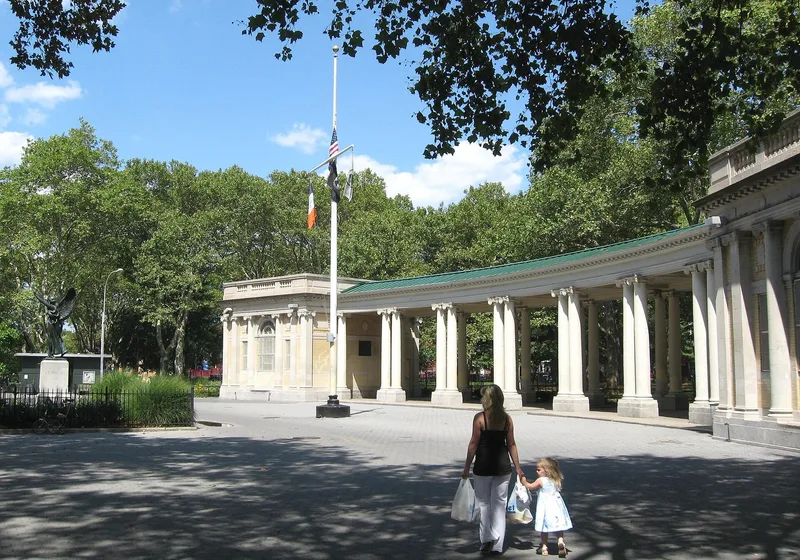
Monsignor McGolrick Park is a 9.1-acre public green in Greenpoint, Brooklyn, built around a crescent-shaped Shelter Pavilion. Designed in 1910 by the Brooklyn firm Helmle & Huberty, the pavilion joins two small brick and limestone buildings with an open colonnade of wooden columns. Its coupled columns and end-pavilion windows recall the Grand Trianon at Versailles. The curve of the building shapes the oval in front of it, and the park's walks radiate from that oval, a French-influenced arrangement rarely found in America. The land was acquired by the city of Brooklyn in 1889 and was first called Winthrop Park. It was renamed for Monsignor Edward McGolrick, longtime pastor of St. Cecelia's Church, in 1941. The park also holds a 1922 Greenpoint War Memorial statue, "Victory," and a 1938 bronze commemorating the Battle of the Monitor and the Merrimac. The park was restored in 1967, but the pavilion remains in poor condition, with fire and vandalism damage to its columns.
Significance in brief: The pavilion is described as an exceptionally handsome focal point in a small park, designed in the Classical Revival style by a prominent Brooklyn firm. The radial walks, laid out in relation to the curve of the building, follow French precedents and are rare in the United States. Statuary creates two further focal points within the park.
Machine-generated summary. This summary was generated by a language model from the official nomination document and has not been reviewed line by line by an editor. It may contain errors. Check the source document before relying on any detail. Source: nomination document (PDF) · National Archives catalog entry. NRHP reference 80002633, listed May 6, 1980. Summary generated October 2026 (model claude-sonnet-5-5, prompt v1.0-2026-10-29, confidence high).
Key facts
| Address | Bounded by Nassau and Driggs Aves., Russell and Monitor Sts., New York |
|---|---|
| County | Brooklyn |
| Listed | May 6, 1980 |
| Reference number | 80002633 |
| Resource type | Structure |
| Period of significance | 1800-1899, 1900- (specific dates 1889; 1910) |
| Architect / builder | Helmle & Huberty |
| Architectural style | Classical Revival |
| Areas of significance | Landscape Architecture, Architecture |
| Level of significance | Local |
| Status (as stated in the nomination) | Deteriorated: the pavilion was not repaired in the 1967 park restoration and is in poor condition, with fire-damaged and vandalized wooden columns supported by metal bands. The end buildings are kept locked. |
| Acreage | 9.1 |
| Coordinates | 40.72460, -73.94338 (NPS GIS) |
What listing means for this property
For a publicly owned building or structure, listing mainly matters when federal funds, permits or licences are involved: projects then go through Section 106 review so effects on the property are considered. Listing also strengthens applications for preservation grants and, for leased income-producing uses, can enable the federal rehabilitation tax credit.
General information, not legal or tax advice. Rules change; confirm with your State Historic Preservation Office or a qualified adviser.
Sources and further reading
- National Park Service, National Register of Historic Places database (snapshot May 2026), reference 80002633.
- Nomination form (PDF, National Archives) — catalog entry
- Wikipedia article (used for cross-checking only; text not reproduced here)
- Wikidata Q49527681
- This listing as JSON
Last updated October 2026. Found an error? See the editorial policy for how to report it.