Fort Greene Historic District

Why it's listed
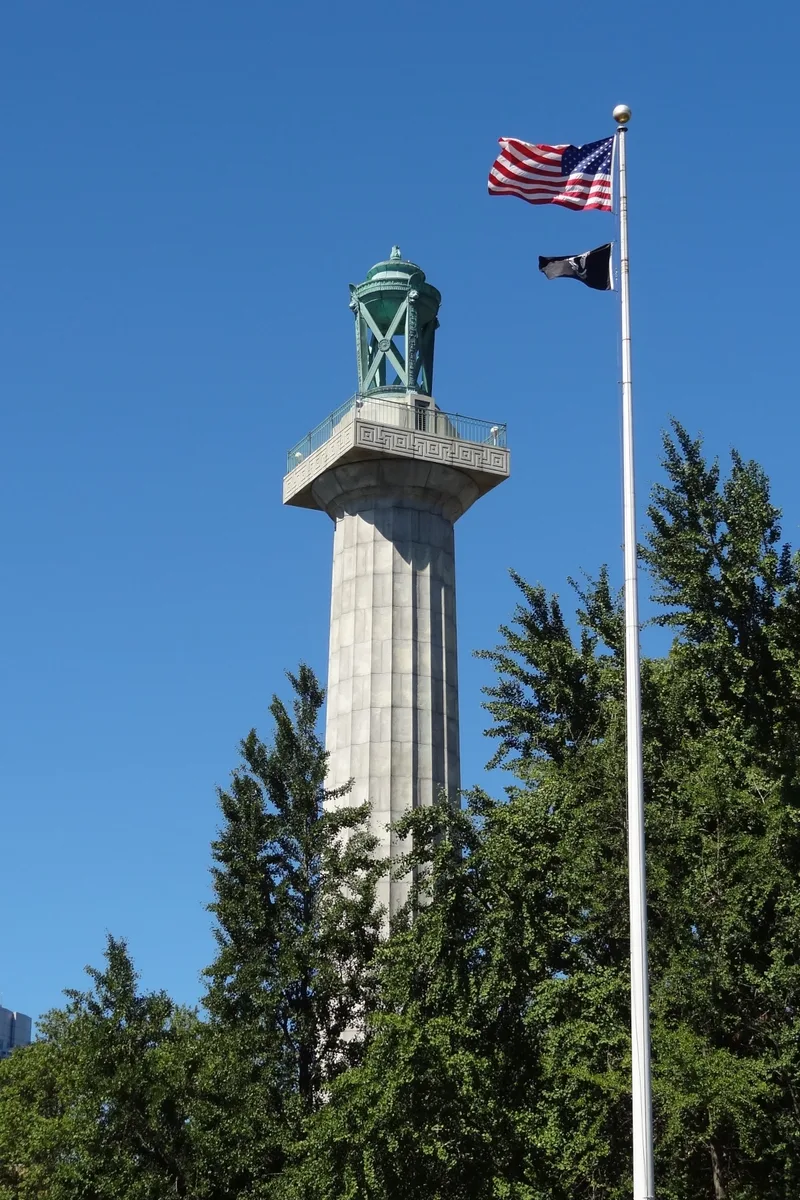
Fort Greene is a Brooklyn neighborhood of about 105 acres, made up of nineteen blocks and a 33-acre park. Its character comes from continuous rows of three- and four-story sandstone townhouses built mostly between 1840 and 1890, largely as speculative development. Facades show the Greek Revival, Italianate, Second Empire and Neo-Grec styles in succession. Churches, commercial buildings and a few later apartment and institutional buildings, including a 1906 Masonic Temple, add variety. Fort Greene Park rises on a rocky prominence where Fort Putnam was begun in 1776 and Fort Greene was built in 1814. Frederick Law Olmsted and Calvert Vaux redesigned it in 1868. At its summit, a 200-foot Doric column designed by McKim, Mead and White and completed in 1908 honors Revolutionary War prisoners who died on British prison ships. Little new construction followed the neighborhood's decline after 1930, so the historic streetscapes and their relationships remain largely intact.
Significance in brief: The nomination calls the district an unusually significant and rare concentration of architecturally distinguished nineteenth-century townhouses, with compatible churches, commercial buildings and later institutional and apartment buildings. It also includes a major urban park designed by Olmsted and Vaux. The park holds the Prison Ship Martyrs' monument by McKim, Mead and White, on the site of 1776 and 1814 fortifications.
Machine-generated summary. This summary was generated by a language model from the official nomination document and has not been reviewed line by line by an editor. It may contain errors. Check the source document before relying on any detail. Source: nomination document (PDF) · National Archives catalog entry. NRHP reference 83001691, listed September 26, 1983. Summary generated October 2026 (model claude-sonnet-5-5, prompt v1.0-2026-10-29, confidence medium).
Key facts
| Address | Roughly bounded by Ft. Greene Pl., Fulton St., Vanderbilt and Myrtle Aves., New York |
|---|---|
| County | Brooklyn |
| Listed | September 26, 1983 |
| Reference number | 83001691 |
| Resource type | District |
| Period of significance | 1840-1932 |
| Architect / builder | various; Olmsted and Vaux (park, 1868); McKim, Mead and White (monument, 1908) |
| Architectural style | Greek Revival, Italianate, Second Empire and Neo-Grec townhouses, with later eclectic styles |
| Areas of significance | Landscape Architecture, Architecture |
| Level of significance | National, Local |
| Status (as stated in the nomination) | Mostly occupied, with a mix of commercial, educational, religious and residential uses. A few buildings are noted as vacant or abandoned, and some are altered or deteriorated. The district is described as experiencing a renaissance. |
| Acreage | 105 |
| Coordinates | 40.68868, -73.97337 (NPS GIS) |
What listing means for this property
This is a historic district. Buildings within its boundary are either contributing (they add to the district's significance) or non-contributing. Owners of contributing income-producing buildings can claim the 20% federal rehabilitation tax credit; homeowners should look at state credits. National Register districts impose no design review by themselves; a local historic district ordinance, if one exists, does (the difference explained).
General information, not legal or tax advice. Rules change; confirm with your State Historic Preservation Office or a qualified adviser.
Sources and further reading
- National Park Service, National Register of Historic Places database (snapshot May 2026), reference 83001691.
- Nomination form (PDF, National Archives) — catalog entry
- Wikipedia article (used for cross-checking only; text not reproduced here)
- Wikidata Q5471252
- This listing as JSON
Last updated October 2026. Found an error? See the editorial policy for how to report it.