Alcove Historic District

Why it's listed
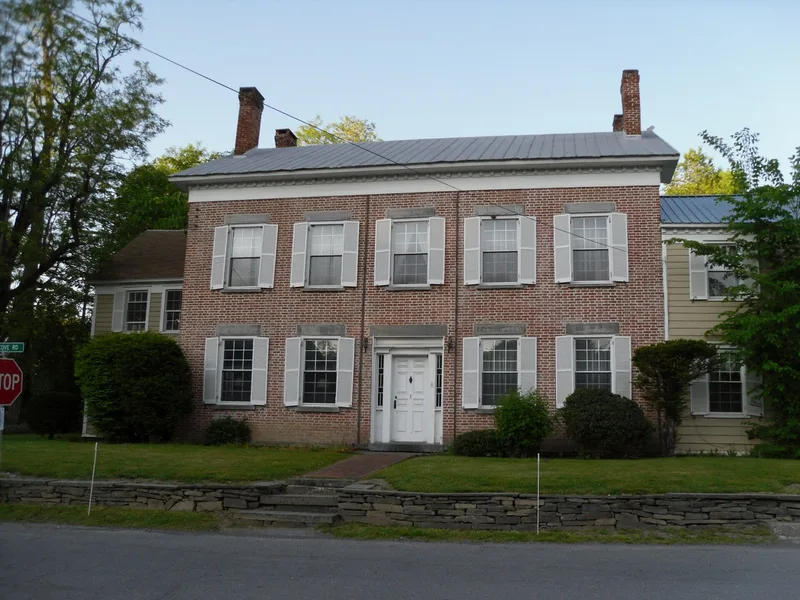
Alcove is a small crossroads community in southeastern Albany County, New York, strung along the Hannacrois Creek. Originally called Stephensville, it was settled about 1790 by Casparus Ackerman and Archibald Stephens and grew around water-powered industry, including a grist mill, flax mill, paper mill, saw mill and a carding and cloth mill. The district of roughly 14 acres preserves a country store with post office, a brick homestead built between 1820 and 1854 for William S. Briggs, a three-and-a-half-story cut stone Federal-style building with stepped gables, several modest Greek Revival-influenced houses, and an Italianate reservoir station moved when the reservoir was created. The Briggs house is considered the most impressive structure and reflects the wealth the mills produced. Nineteenth-century buildings survive largely intact beside the creek that gave the village its reason for being. Remains of mill foundations along the banks have not been surveyed.
Significance in brief: The nomination argues the district is the architectural remnant of a once-flourishing mid-nineteenth-century mill center that grew from hydraulic industry along the creek. The William Briggs homestead reflects the wealth the milling business produced. The largely intact vernacular buildings keep their rural creekside setting and crossroads character.
Machine-generated summary. This summary was generated by a language model from the official nomination document and has not been reviewed line by line by an editor. It may contain errors. Check the source document before relying on any detail. Source: nomination document (PDF) · National Archives catalog entry. NRHP reference 80002582, listed July 24, 1980. Summary generated October 2026 (model claude-sonnet-5-5, prompt v1.0-2026-10-29, confidence medium).
Key facts
| Address | SR 11 and Alcove Rd., Alcove |
|---|---|
| County | Albany County |
| Listed | July 24, 1980 |
| Reference number | 80002582 |
| Resource type | District |
| Period of significance | 1800-1899 |
| Architectural style | Federal, Greek Revival and vernacular nineteenth-century styles, with Italianate features on the reservoir station |
| Areas of significance | Industry, Architecture |
| Level of significance | Local |
| Status (as stated in the nomination) | Condition is rated excellent, good and fair, with some altered buildings. The Briggs homestead has been restored, one building is used as apartments, and the store also houses the post office. The form states there are no modern intrusions. |
| Acreage | 14 |
| Coordinates | 42.46903, -73.92618 (NPS GIS) |
What listing means for this property
This is a historic district. Buildings within its boundary are either contributing (they add to the district's significance) or non-contributing. Owners of contributing income-producing buildings can claim the 20% federal rehabilitation tax credit; homeowners should look at state credits. National Register districts impose no design review by themselves; a local historic district ordinance, if one exists, does (the difference explained).
General information, not legal or tax advice. Rules change; confirm with your State Historic Preservation Office or a qualified adviser.
Sources and further reading
- National Park Service, National Register of Historic Places database (snapshot May 2026), reference 80002582.
- Nomination form (PDF, National Archives) — catalog entry
- Wikipedia article (used for cross-checking only; text not reproduced here)
- Wikidata Q4713373
- This listing as JSON
Last updated October 2026. Found an error? See the editorial policy for how to report it.