Marsh, Alexander, House

Why it's listed
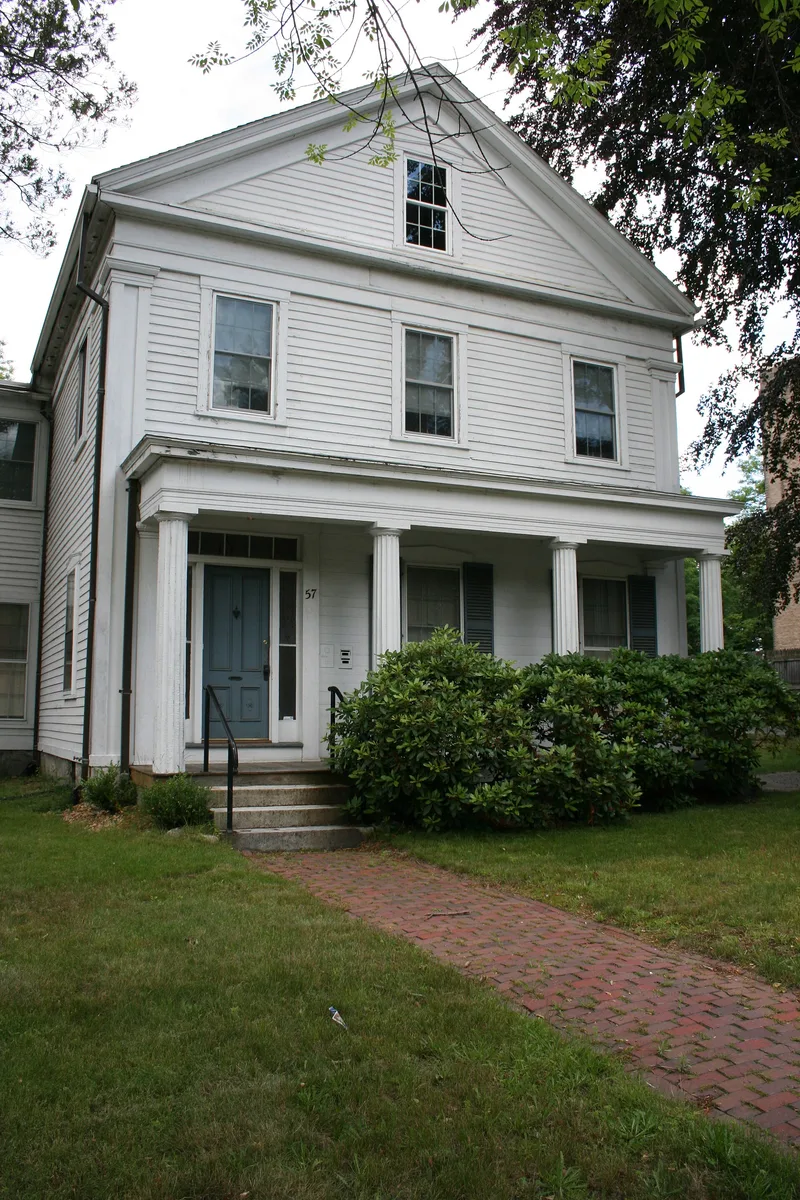
Built in 1848 at 57 Elm Street in Worcester, this clapboard house is a well-preserved example of the side-hall Greek Revival type that was popular in the city during the 1840s and early 1850s. It sits on a rock-faced granite foundation and has corner pilasters, a pedimented gable on the facade, a Doric porch, and a main entry with side lights. Governor Levi Lincoln sold the property in October 1848 to Alexander Marsh, a piano dealer and later barometer manufacturer. Of the houses Lincoln built in his first efforts to develop his Elm Street estate, this is the only one still unaltered on its original site. Marsh moved to a new brick house on the rear of the lot around 1875. His son Henry Alexander Marsh then lived here until 1914. Henry Marsh rose from bank clerk to president of the Central Bank and served as city councilor, alderman and mayor of Worcester.
Significance in brief: The form describes it as an excellent unaltered example of the side-hall Greek Revival house, a type widely popular in Worcester in the 1840s and early 1850s. It is the only house built by Levi Lincoln in his early Elm Street estate development that remains unaltered on its original site. It was also the home of Alexander Marsh and later of his son Henry Alexander Marsh, a banker and mayor of Worcester.
Machine-generated summary. This summary was generated by a language model from the official nomination document and has not been reviewed line by line by an editor. It may contain errors. Check the source document before relying on any detail. Source: nomination document (PDF) · National Archives catalog entry. NRHP reference 80000583, listed March 5, 1980. Summary generated October 2026 (model claude-sonnet-5-5, prompt v1.0-2026-10-29, confidence medium).
Key facts
| Address | 57 Elm St., Worcester |
|---|---|
| County | Worcester County |
| Listed | March 5, 1980 |
| Reference number | 80000583 |
| Resource type | Building |
| Architectural style | Greek Revival |
| Areas of significance | Politics/Government, Architecture |
| Level of significance | State, Local |
| Status (as stated in the nomination) | Present use is residential. |
| Acreage | 0.1 |
| Coordinates | 42.26560, -71.80754 (NPS GIS) |
What listing means for this property
National Register listing is honorary for a privately owned home: it does not by itself restrict what an owner may do with their own money, and it does not require public access. Restrictions come from local landmark or historic-district ordinances, which are separate (how they differ).
Owner-occupied houses are not eligible for the 20% federal rehabilitation tax credit, which applies to income-producing buildings, but many states offer credits for homeowners. Listing also opens the door to preservation easements and to buying a plaque. Start with what listing means for homeowners, renovating a listed house and selling one.
General information, not legal or tax advice. Rules change; confirm with your State Historic Preservation Office or a qualified adviser.
Sources and further reading
- National Park Service, National Register of Historic Places database (snapshot May 2026), reference 80000583.
- Nomination form (PDF, National Archives) — catalog entry
- Wikipedia article (used for cross-checking only; text not reproduced here)
- Wikidata Q4719550
- This listing as JSON
Last updated October 2026. Found an error? See the editorial policy for how to report it.