Glover Street Historic District

Why it's listed
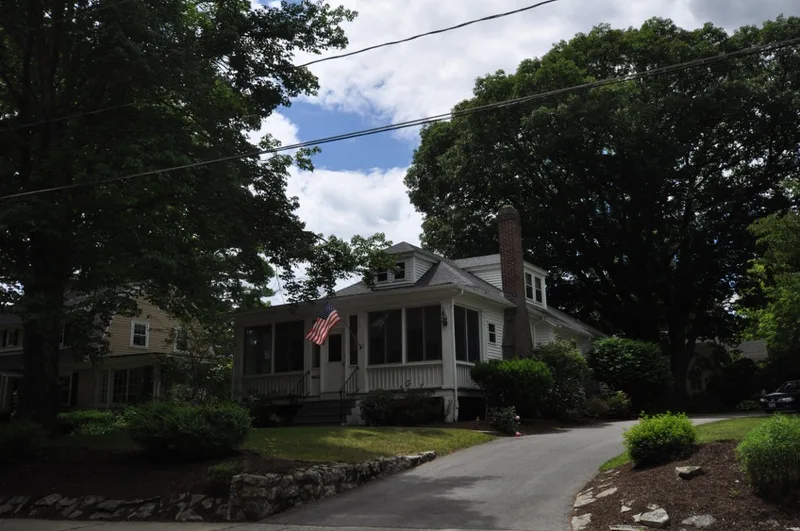
Glover Street in Southbridge, Massachusetts, is a quiet residential neighborhood of nineteen houses and one barn on about five acres. Most are modest middle-class cottages. One five-bay, one-and-a-half story house at High Street probably dates from the late 18th or early 19th century, but the area is mostly late 19th and early 20th century. Six nearly identical Gothic cottages with jigsaw bargeboards date from the first suburban subdivision, probably in the 1880s, and four of them are the best preserved examples of the design in town. A group of seven Colonial Revival and Bungalow-inspired houses, built between about 1910 and 1930, faces a water reservoir on the west side. The land was once part of the forty-acre Clarke-Glover property, and the street was cut through in the 1880s or 1890s. The district reflects how housing for the growing middle class developed near the town's workplaces, and it retains good integrity.
Significance in brief: The district is argued to be significant as an example of new housing types developed in the 19th and early 20th centuries for the expanding middle class. Four of its six Gothic cottages are the best preserved examples of that design left in Southbridge. It is considered eligible at the local level under criteria A and C.
Machine-generated summary. This summary was generated by a language model from the official nomination document and has not been reviewed line by line by an editor. It may contain errors. Check the source document before relying on any detail. Source: nomination document (PDF) · National Archives catalog entry. NRHP reference 89000601, listed June 22, 1989. Summary generated October 2026 (model claude-sonnet-5-5, prompt v1.0-2026-10-29, confidence medium).
Key facts
| Address | Glover St. between High and Poplar Sts., Southbridge |
|---|---|
| County | Worcester County |
| Listed | June 22, 1989 |
| Reference number | 89000601 |
| Resource type | District |
| Period of significance | early 19th century-1880's-ca. 1920's |
| Architectural style | Vernacular styles including Gothic Revival, Queen Anne, Colonial Revival and Bungalow |
| Criteria |
|
| Areas of significance | Industry, Architecture |
| Level of significance | Local |
| Status (as stated in the nomination) | Present use is residential; general condition is stated as good. |
| Acreage | 5 |
| Coordinates | 42.07443, -72.04681 (NPS GIS) |
What listing means for this property
This is a historic district. Buildings within its boundary are either contributing (they add to the district's significance) or non-contributing. Owners of contributing income-producing buildings can claim the 20% federal rehabilitation tax credit; homeowners should look at state credits. National Register districts impose no design review by themselves; a local historic district ordinance, if one exists, does (the difference explained).
General information, not legal or tax advice. Rules change; confirm with your State Historic Preservation Office or a qualified adviser.
Sources and further reading
- National Park Service, National Register of Historic Places database (snapshot May 2026), reference 89000601.
- Nomination form (PDF, National Archives) — catalog entry
- Wikipedia article (used for cross-checking only; text not reproduced here)
- Wikidata Q5572181
- This listing as JSON
Last updated October 2026. Found an error? See the editorial policy for how to report it.