Farnumsville Historic District
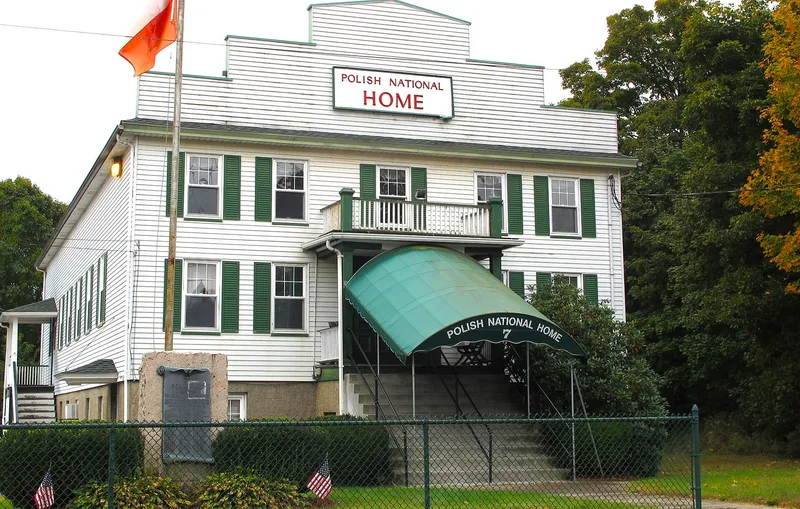

Why it's listed
Farnumsville is a small industrial village in the town of Grafton, Massachusetts, that grew up around the Blackstone River and its water-powered textile mill. The historic district takes in the brick mill complex, which was built in at least eleven stages between 1844 and 1940, along with company housing, commercial buildings, two former schools, social clubs, a former hotel and fire station, a cemetery dating to about 1812, and remnants of the Blackstone Canal. Most houses are simple wood-frame homes built between 1880 and 1920 for mill workers, though styles range from Federal and Greek Revival to Queen Anne and Tudor Revival. The district was listed for its role in the region's industrial development, its planned growth as a mill village, and its architecture. A period of significance from 1810 to 1935 reflects the mill's operation under several owners. Alterations and losses have been modest, so the historic character remains distinct from surrounding areas.
Significance in brief: The district is significant for industry and for community planning and development, since the village grew around a mill on the Blackstone River that supplied power and jobs. It is also significant for architecture, with a full range of vernacular and revival styles built largely for mill workers. Its historic character remains largely intact with few losses.
Machine-generated summary. This summary was generated by a language model from the official nomination document and has not been reviewed line by line by an editor. It may contain errors. Check the source document before relying on any detail. Source: nomination document (PDF) · National Archives catalog entry. NRHP reference 96000052, listed February 16, 1996. Summary generated October 2026 (model claude-sonnet-5-5, prompt v1.0-2026-10-29, confidence medium).
Key facts
| Address | Roughly bounded by Providence Rd., Cross, Main, Harding and Depot Sts. and Maple Ave., Grafton |
|---|---|
| County | Worcester County |
| Listed | February 16, 1996 |
| Reference number | 96000052 |
| Resource type | District |
| Period of significance | 1810 - 1935 |
| Architectural style | Mid-19th Century/Other: Vernacular; Late 19th & 20th Century Revivals/Other: Vernacular |
| Criteria |
|
| Areas of significance | Industry, Community Planning and Development, Architecture |
| Level of significance | Local |
| Status (as stated in the nomination) | Most houses still serve as residences; the Harding Street school and a former hotel are now apartments, the Main Street school is a senior center, and the social clubs retain their original use. The district is described as well preserved with minimal alteration and loss. |
| Acreage | 150 |
| Coordinates | 42.17677, -71.68152 (NPS GIS) |
What listing means for this property
This is a historic district. Buildings within its boundary are either contributing (they add to the district's significance) or non-contributing. Owners of contributing income-producing buildings can claim the 20% federal rehabilitation tax credit; homeowners should look at state credits. National Register districts impose no design review by themselves; a local historic district ordinance, if one exists, does (the difference explained).
General information, not legal or tax advice. Rules change; confirm with your State Historic Preservation Office or a qualified adviser.
Sources and further reading
- National Park Service, National Register of Historic Places database (snapshot May 2026), reference 96000052.
- Nomination form (PDF, National Archives) — catalog entry
- Wikipedia article (used for cross-checking only; text not reproduced here)
- Wikidata Q5436061
- This listing as JSON
Last updated October 2026. Found an error? See the editorial policy for how to report it.