Black Tavern

Why it's listed
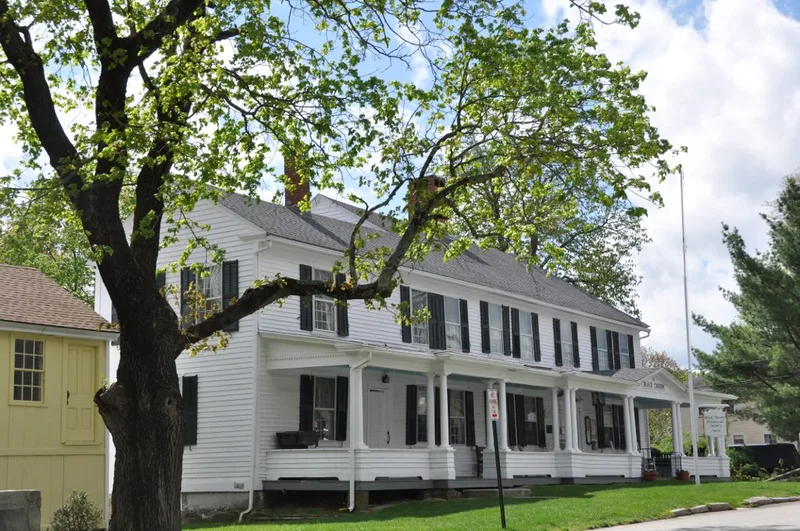
Black Tavern is a Federal-style building at the top of Dudley Hill, built in 1803-1804 by Hezekiah Healy, a militiaman, cabinetmaker and inventor. It began as the Healy Inn and was later called Black Tavern, reportedly because Healy painted it black to reduce maintenance. Facing the village common and meetinghouse, it served stagecoach passengers, horses and local residents on the route between Boston and Hartford. A carpenter shop ell was added about 1810 and a two-story northern ell about 1835. When the Central Turnpike bypassed the hill in 1829, traffic declined. Healy's descendants lived there, and Dr. Charles Goodell used it as a summer home, adding Colonial Revival porches around 1890. It later became a Nichols College dormitory. Its integrity and its place in the early development of Dudley center supported listing under criteria A and C. The interior has deteriorated, though fireplaces, ovens and original doors remain, and a historical society now hopes to restore it.
Significance in brief: The nomination argues that the building is one of the best-preserved Federal-period structures in old Dudley and was an important tavern on the Boston-Hartford stagecoach route. It retains integrity of location, design, setting, materials and workmanship. It also reflects the later development of the community as a summer home and a college dormitory, and it has high archaeological potential.
Machine-generated summary. This summary was generated by a language model from the official nomination document and has not been reviewed line by line by an editor. It may contain errors. Check the source document before relying on any detail. Source: nomination document (PDF) · National Archives catalog entry. NRHP reference 85000981, listed May 9, 1985. Summary generated October 2026 (model claude-sonnet-5-5, prompt v1.0-2026-10-29, confidence high).
Key facts
| Address | Dudley Center Rd., Dudley |
|---|---|
| County | Worcester County |
| Listed | May 9, 1985 |
| Reference number | 85000981 |
| Resource type | Building |
| Period of significance | 1800-1899 |
| Architect / builder | Hezekiah Healy, builder |
| Architectural style | Federal, with Colonial Revival alterations |
| Criteria |
|
| Areas of significance | Commerce, Transportation, Architecture |
| Level of significance | Local |
| Status (as stated in the nomination) | The interior has deteriorated and the building has been poorly maintained in recent years. It was deeded to a non-profit historical society that hopes to restore it. The form lists its status as unoccupied with work in progress. |
| Acreage | 0.2 |
| Within district | Dudley Hill Historic District |
| Coordinates | 42.04570, -71.92952 (NPS GIS) |
What listing means for this property
For an income-producing building, listing (individually or as a contributing building in a district) is the gateway to the 20% federal rehabilitation tax credit on qualified rehabilitation costs, often stackable with state credits. Work claiming the credit must follow the Secretary of the Interior's Standards and be approved in advance.
Listing does not restrict a private owner acting without federal money or permits; where federal funding or licensing is involved, Section 106 review applies.
Noted as vacant in the nomination. Nomination documents can be decades old; current status may differ. If you are considering buying an empty listed property, read the due-diligence checklist.
General information, not legal or tax advice. Rules change; confirm with your State Historic Preservation Office or a qualified adviser.
Sources and further reading
- National Park Service, National Register of Historic Places database (snapshot May 2026), reference 85000981.
- Nomination form (PDF, National Archives) — catalog entry
- Wikipedia article (used for cross-checking only; text not reproduced here)
- Wikidata Q4921995
- This listing as JSON
Last updated October 2026. Found an error? See the editorial policy for how to report it.