Stevens Linen Works Historic District
Also known as: Stevens Mill; Stevens Linen Mill

Why it's listed
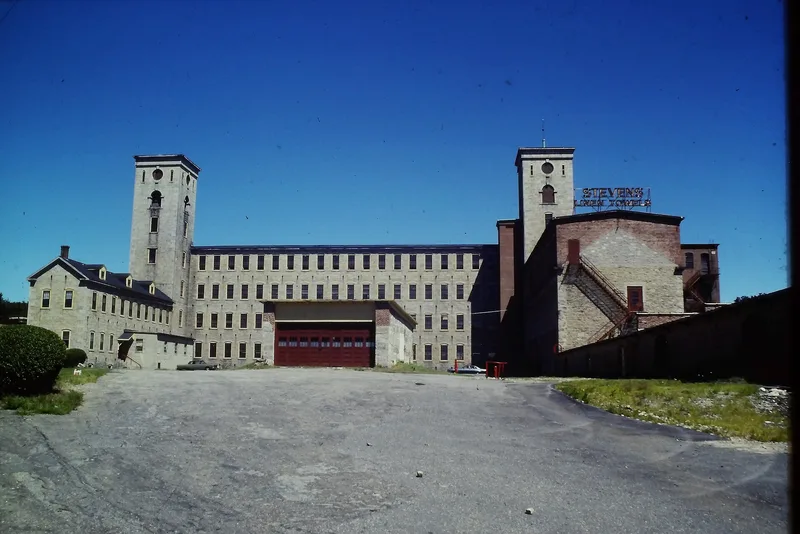
Stevens Linen Works Historic District occupies the east side of Dudley, Massachusetts, along the French River at the Webster line. Its centerpiece is a large granite mill built in the 1860s by Henry Hale Stevens, a pioneer American linen manufacturer. Two tall towers with Romanesque Revival details give the building the look of a medieval fortress. The walls use squared stone in varied colors, and the sills, jambs and cornices carry grooved tooling that the form says is not known elsewhere in New England. Around the mill are a dye house and bleachery, storehouses, a raceway, two dams, a stone bridge and Low Pond, which together supplied waterpower. The district is described as the site of the first, and last, factory in the country to spin flax and weave linen cloth by machine. The mill operated as Stevens Linen Works from about 1865 to 1939. Alterations have been modest, and the rural setting still conveys the period of significance.
Significance in brief: The district is described as the site of the first, and last, factory in the United States to spin flax and weave linen cloth by machine. The granite mill, with its Romanesque Revival towers and distinctive stone tooling, is presented as an exceptional example of mill architecture and early slow-burning construction. The surrounding water system and buildings show how the complex operated as a unified textile works.
Machine-generated summary. This summary was generated by a language model from the official nomination document and has not been reviewed line by line by an editor. It may contain errors. Check the source document before relying on any detail. Source: nomination document (PDF) · National Archives catalog entry. NRHP reference 10000751, listed September 17, 2010. Summary generated October 2026 (model claude-sonnet-5-5, prompt v1.0-2026-10-29, confidence medium).
Key facts
| Address | 8-10 Mill St, 2 W Main St, 2 Curfew Ln, Ardlock Pl, Dudley |
|---|---|
| County | Worcester County |
| Listed | September 17, 2010 |
| Reference number | 10000751 |
| Resource type | District |
| Architect / builder | No record of designer or builder; the form concludes it is very likely Henry Hale Stevens designed the mill. Two floors of the East Ell added in 1900 were designed by the engineering firm of Charles T. Main. |
| Architectural style | Romanesque Revival, Classical Revival, No style |
| Areas of significance | Industry, Architecture, Engineering |
| Level of significance | National, State, Local |
| Status (as stated in the nomination) | Current function listed as vacant/not in use, with some commercial use (pet grooming and boarding, offices). The two noncontributing late 20th-century buildings are scheduled for demolition as part of adaptive reuse of the mill complex. |
| Acreage | 24.3 |
| Coordinates | 42.04951, -71.89217 (NPS GIS) |
What listing means for this property
This is a historic district. Buildings within its boundary are either contributing (they add to the district's significance) or non-contributing. Owners of contributing income-producing buildings can claim the 20% federal rehabilitation tax credit; homeowners should look at state credits. National Register districts impose no design review by themselves; a local historic district ordinance, if one exists, does (the difference explained).
General information, not legal or tax advice. Rules change; confirm with your State Historic Preservation Office or a qualified adviser.
Sources and further reading
- National Park Service, National Register of Historic Places database (snapshot May 2026), reference 10000751.
- Nomination form (PDF, National Archives) — catalog entry
- Wikipedia article (used for cross-checking only; text not reproduced here)
- Wikidata Q17038670
- This listing as JSON
Last updated October 2026. Found an error? See the editorial policy for how to report it.