West Street District

Why it's listed
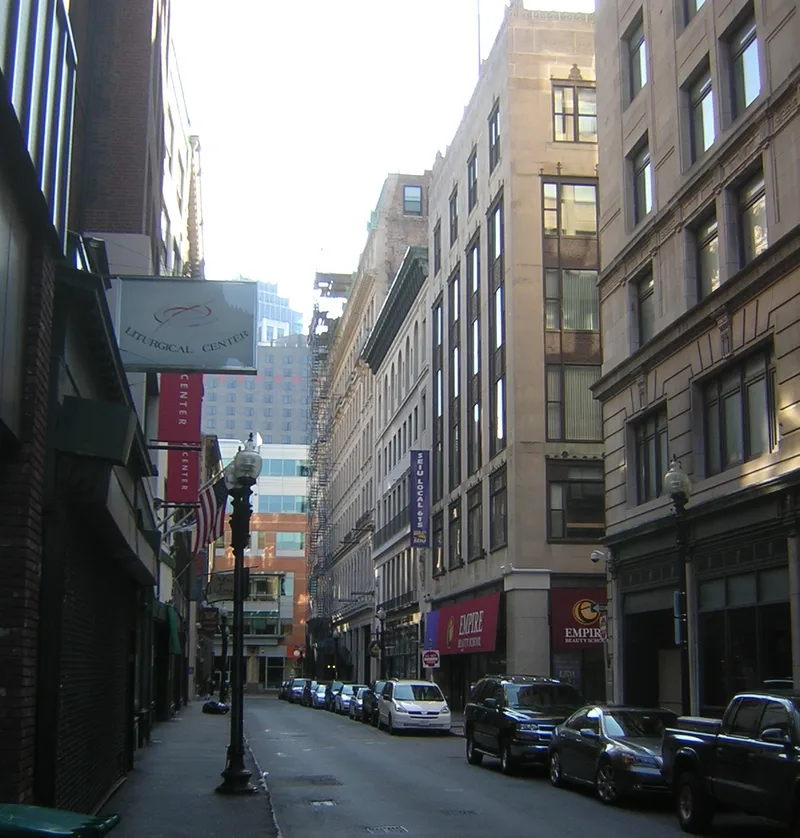
West Street District is a group of early 20th-century commercial buildings in Boston's downtown theatre area. It includes the Lawrence Buildings at 148-9 and 150 Tremont Street, dated in the bibliography to 1903, the Schrafft's building at 16-24 West Street, and the Fabyan Building at 26-32 West Street. The buildings vary in style, with Commercial Style, Renaissance Revival and Classical Revival all represented, but they share a consistent condition: the survey describes them as well-maintained, privately owned and in commercial use. The district was recorded in 1979 as part of a survey of historic resources in the Boston theatre area. That larger group of properties is considered significant for the quality of its architecture, for its association with the city's music industry, especially piano manufacturing, and for the growth of theatres and movie houses. Its buildings reached significance between about 1890 and the 1930s, and West Street contributes examples of the commercial architecture of that period.
Significance in brief: The district is part of the Boston Theatre Multiple Resource Area, which is described as significant for the quality of its architecture and for its links to Boston's music industry and the growth of theatres and movie houses. The area's buildings reached significance between about 1890 and the 1930s. The form describes the district as late 19th and early 20th century commercial buildings.
Machine-generated summary. This summary was generated by a language model from the official nomination document and has not been reviewed line by line by an editor. It may contain errors. Check the source document before relying on any detail. Source: nomination document (PDF) · National Archives catalog entry. NRHP reference 80000455, listed December 9, 1980. Summary generated October 2026 (model claude-sonnet-5-5, prompt v1.0-2026-10-29, confidence medium).
Key facts
| Address | West St., Boston |
|---|---|
| County | Suffolk County |
| Listed | December 9, 1980 |
| Reference number | 80000455 |
| Resource type | District |
| Architectural style | Commercial Style, Renaissance Revival, Classical Revival |
| Areas of significance | Architecture, Performing Arts |
| Level of significance | National, State, Local |
| Status (as stated in the nomination) | Area described as well-maintained, in private ownership and in commercial use. |
| Acreage | 0.6 |
| Coordinates | 42.35509, -71.06313 (NPS GIS) |
What listing means for this property
This is a historic district. Buildings within its boundary are either contributing (they add to the district's significance) or non-contributing. Owners of contributing income-producing buildings can claim the 20% federal rehabilitation tax credit; homeowners should look at state credits. National Register districts impose no design review by themselves; a local historic district ordinance, if one exists, does (the difference explained).
General information, not legal or tax advice. Rules change; confirm with your State Historic Preservation Office or a qualified adviser.
Sources and further reading
- National Park Service, National Register of Historic Places database (snapshot May 2026), reference 80000455.
- Nomination form (PDF, National Archives) — catalog entry
- Wikipedia article (used for cross-checking only; text not reproduced here)
- Wikidata Q7986598
- This listing as JSON
Last updated October 2026. Found an error? See the editorial policy for how to report it.