Tremont Street Subway
Also known as: Green Line

The pin is a point inside the NPS boundary polygon, not a surveyed location.
Why it's listed
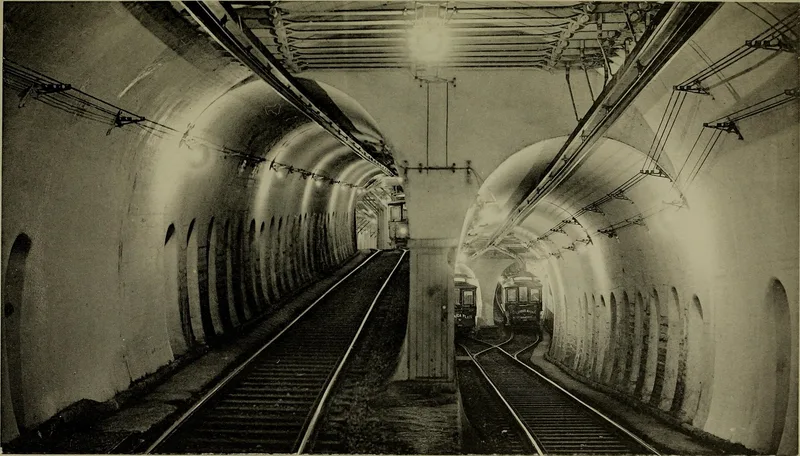
Beneath Tremont and Boylston Streets, along Boston Common and the Public Garden, runs the first subway built in the United States. Ground was broken in 1895, and the first section opened on September 1, 1897, with the full system running by autumn 1898. It was built to relieve streetcar congestion on narrow downtown streets. Engineers combined features of London's deep tubes and Paris's shallow masonry arches to produce a steel and concrete tunnel built mainly in open excavation, a method soon standard across American subway construction. In its first full year the line carried about 50 million rides, and its success led quickly to a similar system in New York City. The section between Court Street and Charles Street remains much as built and still carries Green Line trains. Two original Classical Revival kiosks designed by Edward M. Wheelwright still stand along the Boston Common edge of Tremont Street above the Park Street and Boylston Street stations.
Significance in brief: It was the first underground public transportation system in the United States and only the fifth in the world. Its success led quickly to a similar system in New York City. Boston also developed a hybrid steel-and-concrete tunnel method that became standard in American subway construction.
Machine-generated summary. This summary was generated by a language model from the official nomination document and has not been reviewed line by line by an editor. It may contain errors. Check the source document before relying on any detail. Source: nomination document (PDF) · National Archives catalog entry. NRHP reference 66000788, listed October 15, 1966. Summary generated October 2026 (model claude-sonnet-5-5, prompt v1.0-2026-10-29, confidence medium).
Key facts
| Address | Beneath Tremont, Boylston, and Washington Sts., Boston |
|---|---|
| County | Suffolk County |
| Listed | October 15, 1966 |
| Reference number | 66000788 |
| Resource type | Structure |
| Period of significance | 1897-98 |
| Architect / builder | Chief Engineer: Howard A. Carsen |
| Architectural style | Classical Revival (entrance and exit kiosks, designed by Edward M. Wheelwright) |
| Areas of significance | Transportation |
| Level of significance | National |
| National Historic Landmark | Yes, designated January 29, 1964 |
| Status (as stated in the nomination) | Still in regular operation as part of the MBTA Green Line; the Boylston Street Station and the Park and Boylston kiosks are described as essentially unaltered, and Park Street Station has been enlarged on the northbound side. |
| Acreage | 6 |
| Within district | Boston Common and Public Garden |
| Coordinates | 42.35567, -71.06307 (NPS GIS) |
What listing means for this property
National Register listing is honorary: it recognises significance and does not restrict what a private owner may do without federal money or permits. It unlocks the 20% federal rehabilitation tax credit for income-producing buildings, state credits in many states, and Section 106 review when federal agencies are involved. See what listing means in practice.
General information, not legal or tax advice. Rules change; confirm with your State Historic Preservation Office or a qualified adviser.
Sources and further reading
- National Park Service, National Register of Historic Places database (snapshot May 2026), reference 66000788.
- Nomination form (PDF, National Archives) — catalog entry
- Wikipedia article (used for cross-checking only; text not reproduced here)
- Wikidata Q2451368
- This listing as JSON
Last updated October 2026. Found an error? See the editorial policy for how to report it.