Mount Hope Cemetery

Why it's listed
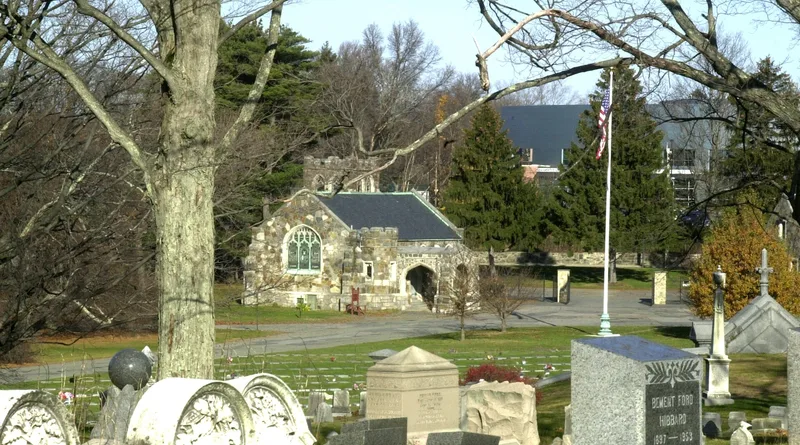
Mount Hope Cemetery covers 125 acres in Boston's Mattapan neighborhood. Consecrated in 1852 as a private burial ground, it was bought by the city in 1857 for $35,000 and became Boston's first publicly owned rural cemetery. David Haggerston laid out the original core, with curving roads, a pond created from wetlands, and mature trees. The grounds hold older family lots, a section for paupers, lots for charitable homes, civic groups, churches and ethnic communities, and about 10,000 veterans' graves. Notable structures include an English Gothic chapel from 1900, an administration building from 1903, a large granite receiving tomb from 1875, and monuments such as the Odd Fellows sculpture by Thomas Ball. About 370,000 people are buried here, 64,000 of them designated city poor. The cemetery was listed for its role as the city's main public burial place and for its surviving landscape and monuments from 1852 to 1959. It remains active today.
Significance in brief: It was Boston's first publicly owned rural cemetery and has been the city's largest and most active public burial ground for over 150 years. It reflects rural cemetery ideals while accommodating paupers, civic groups, ethnic communities and veterans. About 370,000 people are buried there.
Machine-generated summary. This summary was generated by a language model from the official nomination document and has not been reviewed line by line by an editor. It may contain errors. Check the source document before relying on any detail. Source: nomination document (PDF) · National Archives catalog entry. NRHP reference 09000767, listed September 24, 2009. Summary generated October 2026 (model claude-sonnet-5-5, prompt v1.0-2026-10-29, confidence medium).
Key facts
| Address | 355 Walk Hill St., Boston |
|---|---|
| County | Suffolk County |
| Listed | September 24, 2009 |
| Reference number | 09000767 |
| Resource type | Site |
| Period of significance | 1852-1959 |
| Architect / builder | David Haggerston (original layout); Wood and White (chapel); James Mulcahy (administration building); Thomas Ball (Odd Fellows monument) |
| Architectural style | English Gothic (chapel and administration building) |
| Areas of significance | Communications, Landscape Architecture, Social History, Asian |
| Level of significance | Local |
| Status (as stated in the nomination) | Remains an active cemetery, though new burial space is limited. The chapel is used for storage and its tower is in poor repair; the administration building still serves its original function. |
| Acreage | 125.2 |
| Coordinates | 42.28154, -71.10638 (NPS GIS) |
What listing means for this property
Sites (archaeological sites, battlefields, landscapes) are often listed with a restricted address to protect them from looting or disturbance. Listing is honorary for private owners; federal undertakings on or near the site go through Section 106 review, and state laws may protect burials and artefacts regardless of listing.
General information, not legal or tax advice. Rules change; confirm with your State Historic Preservation Office or a qualified adviser.
Sources and further reading
- National Park Service, National Register of Historic Places database (snapshot May 2026), reference 09000767.
- Nomination form (PDF, National Archives) — catalog entry
- Wikipedia article (used for cross-checking only; text not reproduced here)
- Wikidata Q8509207
- This listing as JSON
Last updated October 2026. Found an error? See the editorial policy for how to report it.