Bellingham-Cary House

Why it's listed
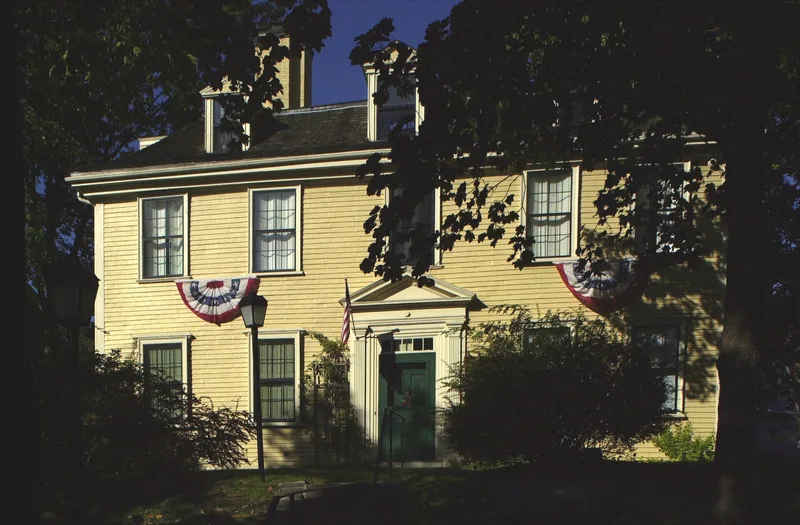
Set on a small hill behind a wide lawn among maple and oak trees in a residential part of Chelsea, this large Federal mansion grew in stages. Its oldest section, now called the "old kitchen," was built in 1659 as a hunting lodge by Gov. Richard Bellingham, who arrived in Massachusetts from England in 1634 and served as governor. The Cary family added a west parlor and two rooms above around the 1750s. In 1791 Samuel Cary, who had prosperous plantations in Grenada, spent $12,000 turning the modest house into an elaborate mansion with a stately staircase and panelling brought from England. The grounds were extensively landscaped, and the estate became known as "The Retreat." The house has a hip roof, pedimented dormers, a Doric pedimented entrance, ten original fireplaces and a double stairway dividing eight rooms. It is considered the only existing house built partly by a founder of the Massachusetts Bay Colony and the last significant 17th-18th century structure in Chelsea. It now serves as a museum.
Significance in brief: It is described as the only existing house built, in part, by one of the founders of the Massachusetts Bay Colony, Gov. Richard Bellingham. It is also the only remaining historically significant 17th-18th century structure in Chelsea. Its 1791 enlargement by Samuel Cary turned it into a showplace known as "The Retreat."
Machine-generated summary. This summary was generated by a language model from the official nomination document and has not been reviewed line by line by an editor. It may contain errors. Check the source document before relying on any detail. Source: nomination document (PDF) · National Archives catalog entry. NRHP reference 74000908, listed September 6, 1974. Summary generated October 2026 (model claude-sonnet-5-5, prompt v1.0-2026-10-29, confidence high).
Key facts
| Address | 34 Parker St., Chelsea |
|---|---|
| County | Suffolk County |
| Listed | September 6, 1974 |
| Reference number | 74000908 |
| Resource type | Building |
| Period of significance | 17th and 18th centuries (specific dates 1659, c.1750, and 1791) |
| Architect / builder | Gov. Richard Bellingham (original 1659 section); Samuel Cary (1791 enlargement) |
| Architectural style | Federal |
| Areas of significance | Politics/Government, Architecture |
| Level of significance | State |
| Status (as stated in the nomination) | Occupied and in use as a museum; owned by the Gov. Bellingham-Cary House Association since 1908. Condition is marked as altered, on its original site. |
| Acreage | 1.2 |
| Coordinates | 42.39777, -71.03804 (NPS GIS) |
What listing means for this property
National Register listing is honorary for a privately owned home: it does not by itself restrict what an owner may do with their own money, and it does not require public access. Restrictions come from local landmark or historic-district ordinances, which are separate (how they differ).
Owner-occupied houses are not eligible for the 20% federal rehabilitation tax credit, which applies to income-producing buildings, but many states offer credits for homeowners. Listing also opens the door to preservation easements and to buying a plaque. Start with what listing means for homeowners, renovating a listed house and selling one.
General information, not legal or tax advice. Rules change; confirm with your State Historic Preservation Office or a qualified adviser.
Sources and further reading
- National Park Service, National Register of Historic Places database (snapshot May 2026), reference 74000908.
- Nomination form (PDF, National Archives) — catalog entry
- Wikipedia article (used for cross-checking only; text not reproduced here)
- Wikidata Q4884019
- This listing as JSON
Last updated October 2026. Found an error? See the editorial policy for how to report it.