Kingsbury-Whitaker House
Also known as: Glendoon House

Why it's listed
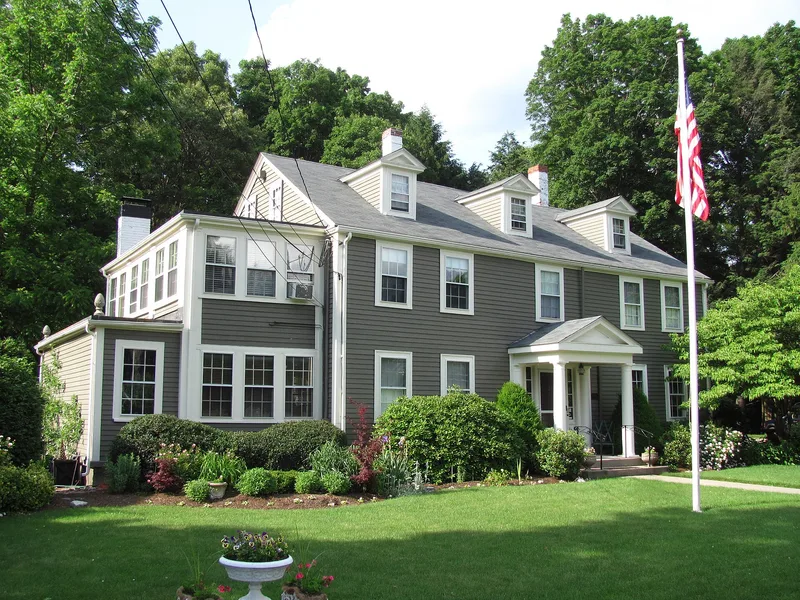
Set on a lot of less than an acre at 53 Glendoon Street in Needham, this 2 1/2-story clapboard house grew over roughly two centuries. Its eastern section contains framing from the early to mid 18th century, linked to Deacon Timothy Kingsbury, an early town clerk, selectman and church deacon. In 1839 Boston merchant Edgar Kimball Whitaker bought it and had it greatly enlarged, with a new central entrance and wide hall. Whitaker later helped bring the railroad to Needham. Later owners added an ell around 1870, a colonial-style entry porch and dormers around 1920, and western wings in the 1920s and 1930s. A barn was removed, and a new street and house lots were laid out in 1924, reflecting Needham's suburban growth. The Needham Historical Society bought the property in 1949 and uses it as a meeting place, library and museum. Its layers show a simple early dwelling becoming a large suburban residence.
Significance in brief: The house shows how an early dwelling grew into a substantial farmhouse and then a suburban residence, reflecting changing building practices over two centuries. It is tied to two prominent Needham citizens, Deacon Timothy Kingsbury and Edgar Kimball Whitaker. It also illustrates Needham's change from an isolated rural community to a Boston suburb.
Machine-generated summary. This summary was generated by a language model from the official nomination document and has not been reviewed line by line by an editor. It may contain errors. Check the source document before relying on any detail. Source: nomination document (PDF) · National Archives catalog entry. NRHP reference 90001080, listed July 12, 1990. Summary generated October 2026 (model claude-sonnet-5-5, prompt v1.0-2026-10-29, confidence high).
Key facts
| Address | 53 Glendoon St., Needham |
|---|---|
| County | Norfolk County |
| Listed | July 12, 1990 |
| Reference number | 90001080 |
| Resource type | Building |
| Period of significance | ca. 1720-1930 |
| Architect / builder | Kingsbury, Deacon Timothy; Whitaker, Edgar Kimball |
| Architectural style | Colonial/Postmedieval English; Early Republic/Federal |
| Criteria |
|
| Areas of significance | Community Planning and Development, Exploration/Settlement, Architecture |
| Level of significance | Local |
| Status (as stated in the nomination) | Used by the Needham Historical Society as a meeting place, library and museum, with a caretaker's apartment in the ell. |
| Acreage | 0.9 |
| Coordinates | 42.28171, -71.23973 (NPS GIS) |
What listing means for this property
National Register listing is honorary for a privately owned home: it does not by itself restrict what an owner may do with their own money, and it does not require public access. Restrictions come from local landmark or historic-district ordinances, which are separate (how they differ).
Owner-occupied houses are not eligible for the 20% federal rehabilitation tax credit, which applies to income-producing buildings, but many states offer credits for homeowners. Listing also opens the door to preservation easements and to buying a plaque. Start with what listing means for homeowners, renovating a listed house and selling one.
General information, not legal or tax advice. Rules change; confirm with your State Historic Preservation Office or a qualified adviser.
Sources and further reading
- National Park Service, National Register of Historic Places database (snapshot May 2026), reference 90001080.
- Nomination form (PDF, National Archives) — catalog entry
- Wikipedia article (used for cross-checking only; text not reproduced here)
- Wikidata Q6413152
- This listing as JSON
Last updated October 2026. Found an error? See the editorial policy for how to report it.