Yale Avenue Historic District

Why it's listed
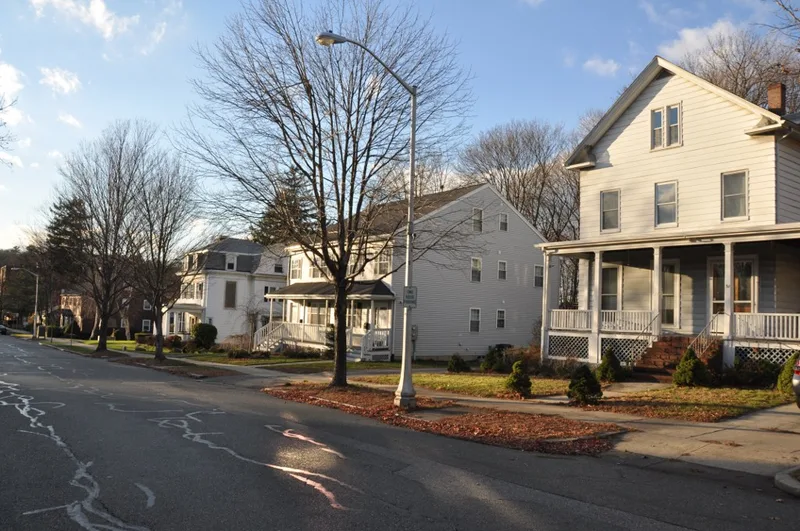
Yale Avenue is a short residential street of eight contiguous houses west of Wakefield's town common. It was laid out in 1863 on land once owned by tin ware manufacturer Burrage Yale. After his death the land was divided into house lots that were quickly bought and built on, mostly by Boston businessmen who could commute by rail. The resulting houses are large, well built and richly detailed. Four are Italianate, and the others show Mansard, Queen Anne, Stick and Colonial Revival styles. Examples include a ca. 1865 Italianate house with quoins and paired brackets, a Mansard-roofed house of 1863, and one of only three Stick Style houses left in town. Few irreversible changes have occurred, and several properties keep their carriage houses, barns or garages. The district was listed for its architecture and for showing how Wakefield grew into a prosperous suburb of Boston in the later nineteenth century.
Significance in brief: The nomination argues that Yale Avenue is the best preserved of Wakefield's earliest neighborhoods developed after commuter rail service to Boston began. Prosperous Boston businessmen built large, stylish houses here, giving a fine collection of Italianate, Second Empire (Mansard), Stick, and Queen Anne residences. The district reflects the first phase of Wakefield's change into an affluent commuter suburb.
Machine-generated summary. This summary was generated by a language model from the official nomination document and has not been reviewed line by line by an editor. It may contain errors. Check the source document before relying on any detail. Source: nomination document (PDF) · National Archives catalog entry. NRHP reference 89000756, listed July 6, 1989. Summary generated October 2026 (model claude-sonnet-5-5, prompt v1.0-2026-10-29, confidence high).
Key facts
| Address | 16--25 Yale Ave., Wakefield |
|---|---|
| County | Middlesex County |
| Listed | July 6, 1989 |
| Reference number | 89000756 |
| Resource type | District |
| Period of significance | 1860-1900 |
| Architectural style | Italianate, Second Empire (Mansard), Stick, Queen Anne, with one Colonial Revival house |
| Criteria |
|
| Areas of significance | Community Planning and Development, Architecture |
| Level of significance | Local |
| Status (as stated in the nomination) | Present use is residential, and the houses are in good condition with few irreversible alterations. Four have aluminum siding or asphalt shingles on one or more sides. |
| Acreage | 2 |
| Coordinates | 42.50473, -71.07436 (NPS GIS) |
What listing means for this property
This is a historic district. Buildings within its boundary are either contributing (they add to the district's significance) or non-contributing. Owners of contributing income-producing buildings can claim the 20% federal rehabilitation tax credit; homeowners should look at state credits. National Register districts impose no design review by themselves; a local historic district ordinance, if one exists, does (the difference explained).
General information, not legal or tax advice. Rules change; confirm with your State Historic Preservation Office or a qualified adviser.
Sources and further reading
- National Park Service, National Register of Historic Places database (snapshot May 2026), reference 89000756.
- Nomination form (PDF, National Archives) — catalog entry
- Wikipedia article (used for cross-checking only; text not reproduced here)
- Wikidata Q8047348
- This listing as JSON
Last updated October 2026. Found an error? See the editorial policy for how to report it.