University Museum
Also known as: Peabody Museum; Museum of Comparative Zoology

Why it's listed
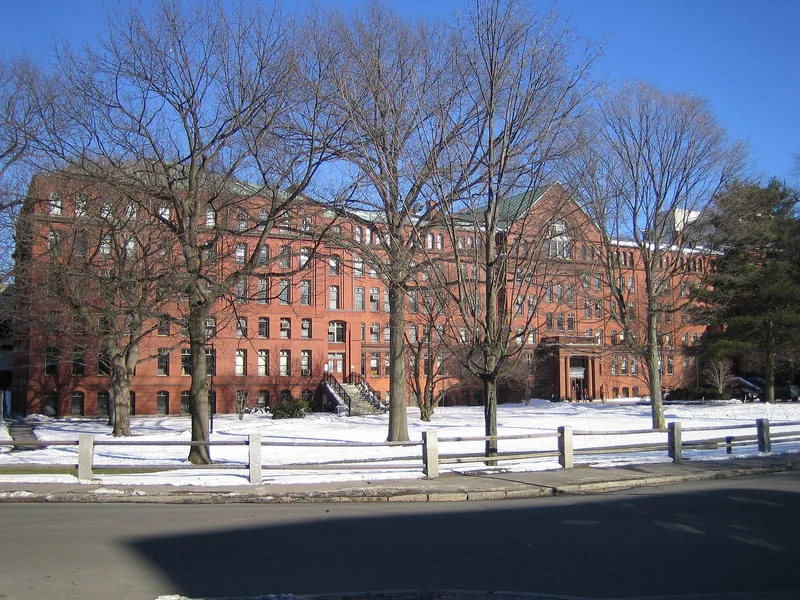
Rising six levels in a U-shaped plan, this brick and brownstone complex on Divinity Avenue in Cambridge houses Harvard's natural history and anthropology collections. Construction began in 1859 with a spare rectangular block designed by Henry Greenough and George Snell for the Museum of Comparative Zoology. Over almost sixty years, twelve more sections were added by seven firms, including wings for the Peabody Museum, mineralogy, geology and botany. Consistent materials and plain design give the whole a notable unity, with a practical, warehouse-like directness. Louis Agassiz conceived the museum as an independent institution and used it as a teaching tool for training naturalists; Harvard took it over in 1876. His son Alexander Agassiz directed its growth. The complex also holds the Ware Collection of Glass Flowers and the Peabody Museum, the nation's only anthropology museum at its founding in 1866. It was listed for its ties to scientific and intellectual history, to Agassiz, and for its architecture.
Significance in brief: The nomination argues the museum was an important institution in museum history, founded by Louis Agassiz, who pioneered the museum as an educational tool by combining zoology, mineralogy, botany and anthropology collections. It also cites the unusual architectural unity of a building assembled over about sixty years in a simple Italian Renaissance manner using consistent materials.
Machine-generated summary. This summary was generated by a language model from the official nomination document and has not been reviewed line by line by an editor. It may contain errors. Check the source document before relying on any detail. Source: nomination document (PDF) · National Archives catalog entry. NRHP reference 86002081, listed September 12, 1986. Summary generated October 2026 (model claude-sonnet-5-5, prompt v1.0-2026-10-29, confidence high).
Key facts
| Address | 11--25 Divinity Ave., Cambridge |
|---|---|
| County | Middlesex County |
| Listed | September 12, 1986 |
| Reference number | 86002081 |
| Resource type | Building |
| Architect / builder | Henry Greenough and George Snell (1859 original section); later Robert H. Slack, George R. Shaw, Stone, Carpenter & Co., Shaw & Hunnewell, Walter S. Burke and others |
| Architectural style | Italian Renaissance |
| Criteria |
|
| Areas of significance | Education, Science |
| Level of significance | State |
| Status (as stated in the nomination) | Present use is museum; originally built as a museum and still used as one. |
| Acreage | 0.4 |
| Coordinates | 42.37854, -71.11539 (NPS GIS) |
What listing means for this property
For a publicly owned building or structure, listing mainly matters when federal funds, permits or licences are involved: projects then go through Section 106 review so effects on the property are considered. Listing also strengthens applications for preservation grants and, for leased income-producing uses, can enable the federal rehabilitation tax credit.
General information, not legal or tax advice. Rules change; confirm with your State Historic Preservation Office or a qualified adviser.
Sources and further reading
- National Park Service, National Register of Historic Places database (snapshot May 2026), reference 86002081.
- Nomination form (PDF, National Archives) — catalog entry
- Wikipedia article (used for cross-checking only; text not reproduced here)
- Wikidata Q7894832
- This listing as JSON
Last updated October 2026. Found an error? See the editorial policy for how to report it.