Train, Samuel, House

Why it's listed
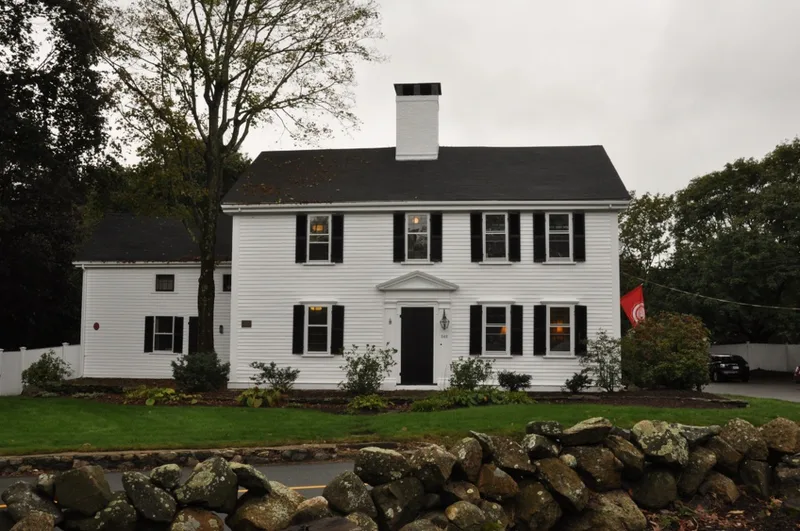
Built in 1738, this two-story farmhouse on Winter Street in Weston sits on slightly less than an acre. It has a central chimney, a ridge roof, white clapboards, a fieldstone foundation and a pedimented doorway on a four-bay facade. Inside, the earliest type of full two-story central-chimney plan survives, with three main rooms per floor, each with a fireplace, a stenciled parlor wall, a bee-hive oven and a pegged oak frame. The house keeps the salt-box plan but with a full second story, which marks a stage in the development of early New England houses. For 106 years it belonged to three successive Samuel Trains. They served as selectmen and in the militia, and the second helped establish Weston's Baptist Society. The third Samuel's brother Charles became its first settled minister and later served in the state legislature. A wing and ell were added about 1875, when a dairy farm operated on the property, and a link was built in 1965.
Significance in brief: The house is presented as an excellent example of one stage in the development of early New England houses, keeping the salt-box plan but with a full second story. It is also significant as the home for 106 years of three successive Samuel Trains, who held town offices, served in the militia and took part in town schools and religious life.
Machine-generated summary. This summary was generated by a language model from the official nomination document and has not been reviewed line by line by an editor. It may contain errors. Check the source document before relying on any detail. Source: nomination document (PDF) · National Archives catalog entry. NRHP reference 76000286, listed December 12, 1976. Summary generated October 2026 (model claude-sonnet-5-5, prompt v1.0-2026-10-29, confidence high).
Key facts
| Address | 342 Winter St., Weston |
|---|---|
| County | Middlesex County |
| Listed | December 12, 1976 |
| Reference number | 76000286 |
| Resource type | Building |
| Period of significance | 1738 to present time |
| Architect / builder | John Train |
| Architectural style | Vernacular |
| Areas of significance | Military, Architecture, Religion, Agriculture |
| Level of significance | Local |
| Status (as stated in the nomination) | Occupied private residence in excellent condition; altered with additions around 1875 and a connecting link in 1965. |
| Acreage | 1 |
| Coordinates | 42.32225, -71.32466 (NPS GIS) |
What listing means for this property
National Register listing is honorary for a privately owned home: it does not by itself restrict what an owner may do with their own money, and it does not require public access. Restrictions come from local landmark or historic-district ordinances, which are separate (how they differ).
Owner-occupied houses are not eligible for the 20% federal rehabilitation tax credit, which applies to income-producing buildings, but many states offer credits for homeowners. Listing also opens the door to preservation easements and to buying a plaque. Start with what listing means for homeowners, renovating a listed house and selling one.
General information, not legal or tax advice. Rules change; confirm with your State Historic Preservation Office or a qualified adviser.
Sources and further reading
- National Park Service, National Register of Historic Places database (snapshot May 2026), reference 76000286.
- Nomination form (PDF, National Archives) — catalog entry
- Wikipedia article (used for cross-checking only; text not reproduced here)
- Wikidata Q7412794
- This listing as JSON
Last updated October 2026. Found an error? See the editorial policy for how to report it.