Thoreau-Alcott House

Why it's listed
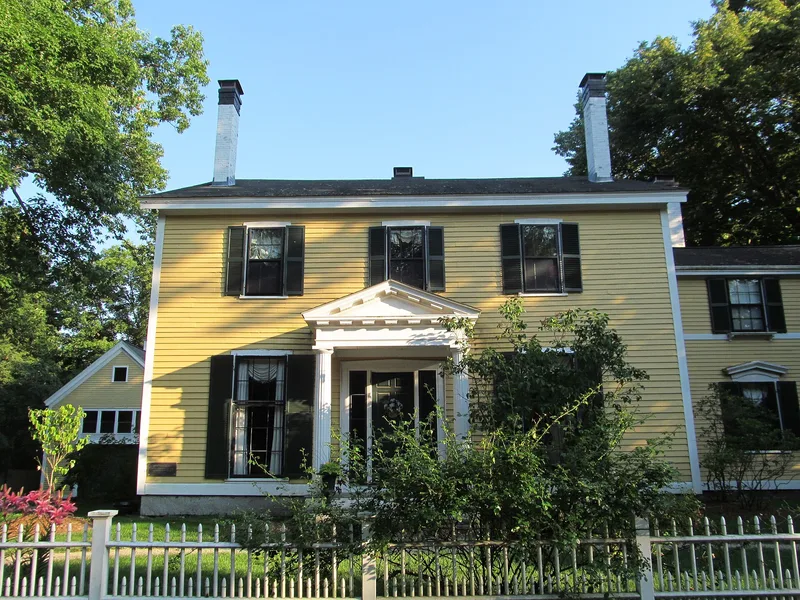
Set back from Main Street in Concord behind a tall hemlock hedge, this clapboard house was built around 1820 by the local builder Josiah Davis. In 1849 John Thoreau and his son Henry David renovated it, adding a pedimented portico with Doric columns, a mahogany stair railing and a south wing for the family pencil factory. Henry David Thoreau lived here during his most productive years, writing Walden and Cape Cod, and died in the front parlor in 1862. In 1877 the house was sold to Anna Alcott Pratt. Louisa May Alcott, by then financially successful, paid most of the cost and funded a west wing with a library and a porch. Her parents Bronson and Abigail Alcott moved in, and the library hosted meetings of the School of Philosophy. The house has changed little since the 1880s, apart from its paint color and the removal of an outside staircase.
Significance in brief: It was the home of Henry David Thoreau from 1849 until his death in 1862, the period in which he wrote Walden and Cape Cod, and it housed the family pencil business. In 1877 Louisa May Alcott helped buy it for her parents and her sister's family, linking it to the Alcott family and the School of Philosophy. It has changed very little since the 1880s.
Machine-generated summary. This summary was generated by a language model from the official nomination document and has not been reviewed line by line by an editor. It may contain errors. Check the source document before relying on any detail. Source: nomination document (PDF) · National Archives catalog entry. NRHP reference 76000247, listed July 12, 1976. Summary generated October 2026 (model claude-sonnet-5-5, prompt v1.0-2026-10-29, confidence high).
Key facts
| Address | 255 Main St., Concord |
|---|---|
| County | Middlesex County |
| Listed | July 12, 1976 |
| Reference number | 76000247 |
| Resource type | Building |
| Period of significance | 1800-1899 |
| Architect / builder | Josiah Davis |
| Architectural style | Greek Revival |
| Areas of significance | Literature, Philosophy, Social History |
| Level of significance | National |
| Status (as stated in the nomination) | Occupied as a private residence, in good condition, and described as virtually unaltered since the 1880s. |
| Acreage | 0.8 |
| Coordinates | 42.45845, -71.35791 (NPS GIS) |
What listing means for this property
National Register listing is honorary for a privately owned home: it does not by itself restrict what an owner may do with their own money, and it does not require public access. Restrictions come from local landmark or historic-district ordinances, which are separate (how they differ).
Owner-occupied houses are not eligible for the 20% federal rehabilitation tax credit, which applies to income-producing buildings, but many states offer credits for homeowners. Listing also opens the door to preservation easements and to buying a plaque. Start with what listing means for homeowners, renovating a listed house and selling one.
General information, not legal or tax advice. Rules change; confirm with your State Historic Preservation Office or a qualified adviser.
Sources and further reading
- National Park Service, National Register of Historic Places database (snapshot May 2026), reference 76000247.
- Nomination form (PDF, National Archives) — catalog entry
- Wikipedia article (used for cross-checking only; text not reproduced here)
- Wikidata Q7796188
- This listing as JSON
Last updated October 2026. Found an error? See the editorial policy for how to report it.