Temple, Joseph, House

Why it's listed
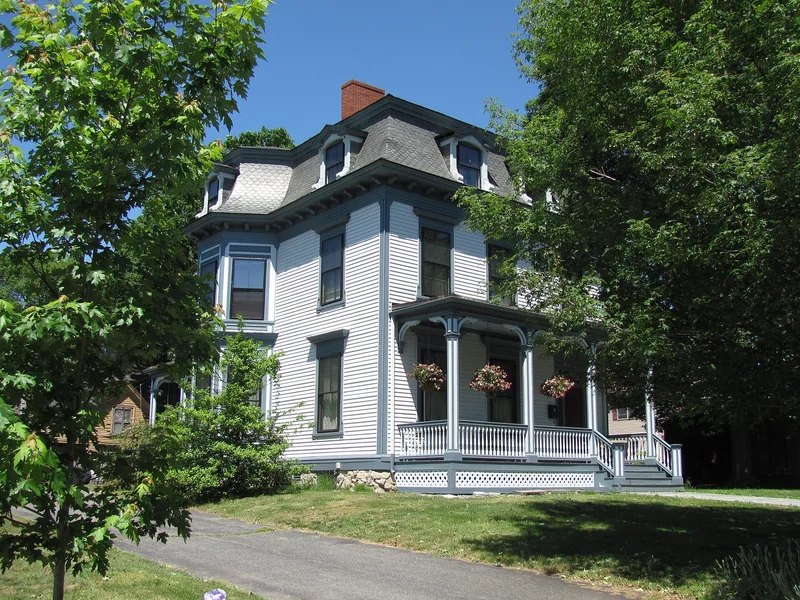
Built in 1872 at 42 Chute Street in Reading, Massachusetts, this Second Empire house was the home of Joseph S. Temple, a local necktie manufacturer. The clapboard dwelling has a gracefully carved mansard roof with a decorative slate surface, supported by stubby brackets. Long windows are topped with dentiled crown moldings, and the main door has shouldered-architrave trim. The porch and pilasters combine Italianate and Eastlake elements, while three-story side bays and side porches give the house a picturesque profile. A barn and a granite retaining wall remain on the property. Chute Street was laid out in 1848 as the town's third development, following the arrival of the railroad. Temple entered the necktie business in 1866, and his firm eventually produced about 250,000 ties a year. The house was listed for its association with him and as a well-preserved example of Second Empire design.
Significance in brief: The house is significant for its link to Joseph S. Temple, an important local necktie manufacturer, and as a good example of Second Empire architecture. It retains integrity of location, design, setting, materials, workmanship and feeling.
Machine-generated summary. This summary was generated by a language model from the official nomination document and has not been reviewed line by line by an editor. It may contain errors. Check the source document before relying on any detail. Source: nomination document (PDF) · National Archives catalog entry. NRHP reference 84002835, listed July 19, 1984. Summary generated October 2026 (model claude-sonnet-5-5, prompt v1.0-2026-10-29, confidence medium).
Key facts
| Address | 42 Chute St., Reading |
|---|---|
| County | Middlesex County |
| Listed | July 19, 1984 |
| Reference number | 84002835 |
| Resource type | Building |
| Architectural style | French Second Empire |
| Criteria |
|
| Areas of significance | Industry, Architecture |
| Level of significance | Local |
| Acreage | 0.9 |
| Coordinates | 42.52365, -71.10860 (NPS GIS) |
What listing means for this property
Religious properties are listed for their architectural or historical significance, not their religious use. Listing is honorary and does not restrict the congregation's use of the building. The federal rehabilitation credit is generally unavailable unless part of the building is income-producing; some state programmes and preservation grants do cover religious buildings. Federal funding or permits trigger Section 106 review.
General information, not legal or tax advice. Rules change; confirm with your State Historic Preservation Office or a qualified adviser.
Sources and further reading
- National Park Service, National Register of Historic Places database (snapshot May 2026), reference 84002835.
- Nomination form (PDF, National Archives) — catalog entry
- Wikipedia article (used for cross-checking only; text not reproduced here)
- Wikidata Q6287382
- This listing as JSON
Last updated October 2026. Found an error? See the editorial policy for how to report it.