Parker Tavern

Why it's listed
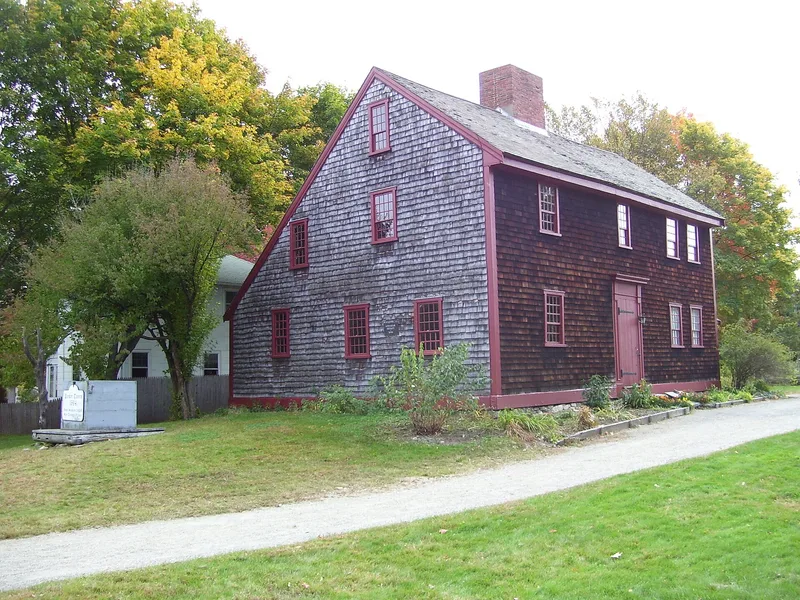
Parker Tavern is a two-story saltbox house with an attic on Washington Street in Reading, Massachusetts. Built in 1694 by blacksmith Abraham Bryant Jr., it is regarded as the oldest documented house in the town and an outstanding local example of 17th-century construction. It has a central brick chimney, a lean-to sloping to the east, wooden shingle siding and a fieldstone foundation. Its occupants included Colonel Ebenezer Nichols, a town moderator, selectman and representative, and Ephraim Parker, whose licensed inn from 1770 to 1785 gave the building its name. During the American Revolution it served as prison quarters for Colonel Archibald Campbell, seven officers and twenty-two servants, captured in Boston Harbor in 1776. The Sweetser family owned it for over a century before the Reading Antiquarian Society acquired it in 1923, restored it between 1923 and 1930, and added a custodian's ell in 1964-65. The Society keeps it as a museum.
Significance in brief: It is described as the oldest documented house in Reading and an outstanding local example of 17th-century building methods. It was home to several figures in the town's history, including Colonel Ebenezer Nichols, and operated as a licensed inn from 1770 to 1785. During the Revolution it housed Colonel Archibald Campbell and his officers as paroled prisoners.
Machine-generated summary. This summary was generated by a language model from the official nomination document and has not been reviewed line by line by an editor. It may contain errors. Check the source document before relying on any detail. Source: nomination document (PDF) · National Archives catalog entry. NRHP reference 75000286, listed August 19, 1975. Summary generated October 2026 (model claude-sonnet-5-5, prompt v1.0-2026-10-29, confidence medium).
Key facts
| Address | 103 Washington St., Reading |
|---|---|
| County | Middlesex County |
| Listed | August 19, 1975 |
| Reference number | 75000286 |
| Resource type | Building |
| Period of significance | 1600-1699, 1700-1799, 1800-1899, 1900- (specific date 1694) |
| Architect / builder | Abraham Bryant, Jr., blacksmith |
| Architectural style | 17th-century saltbox |
| Areas of significance | Military, Architecture |
| Level of significance | Local |
| Status (as stated in the nomination) | Preserved and operated as a museum by the Reading Antiquarian Society; condition listed as good and altered. |
| Acreage | 0.6 |
| Coordinates | 42.52018, -71.10654 (NPS GIS) |
What listing means for this property
For an income-producing building, listing (individually or as a contributing building in a district) is the gateway to the 20% federal rehabilitation tax credit on qualified rehabilitation costs, often stackable with state credits. Work claiming the credit must follow the Secretary of the Interior's Standards and be approved in advance.
Listing does not restrict a private owner acting without federal money or permits; where federal funding or licensing is involved, Section 106 review applies.
General information, not legal or tax advice. Rules change; confirm with your State Historic Preservation Office or a qualified adviser.
Sources and further reading
- National Park Service, National Register of Historic Places database (snapshot May 2026), reference 75000286.
- Nomination form (PDF, National Archives) — catalog entry
- Wikipedia article (used for cross-checking only; text not reproduced here)
- Wikidata Q7138380
- This listing as JSON
Last updated October 2026. Found an error? See the editorial policy for how to report it.