Parsonage, The
Also known as: Horatio Alger House

Why it's listed
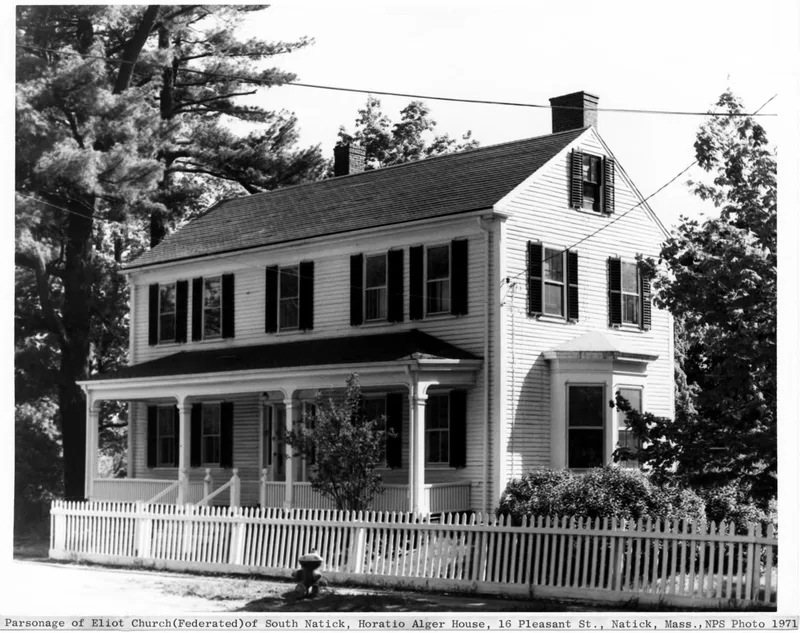
This two-story white clapboard house at 16 Pleasant Street in Natick, Massachusetts, has served as the parsonage of Eliot Church for generations. Said to date from about 1820, it has a gable roof, a five-bay front, a porch with square columns, a bay window added in the mid-nineteenth century, and a rear ell with a later garage. It is recognized for its link to Horatio Alger, the author of boys' stories such as Ragged Dick (1867). Alger spent his summers here from 1866 to 1877, resumed the practice after nearly two years in the West, and retired to Natick in 1898, dying there in 1899. His tales presented virtue rewarded by wealth and honor, and one writer called him the most successful writer of boys' stories in American literature. The house is described as relatively unchanged since his time, with a scenic setting near the Charles River, and it still functions as a parsonage.
Significance in brief: The nomination ties the house to author Horatio Alger, who summered there from 1866 to 1877 and again after about two years in the West, then retired nearby in 1898. His boys' stories, such as Ragged Dick (1867), dramatized the belief that virtue is rewarded with wealth and honor. The nomination argues he left a profound though intangible mark on American history.
Machine-generated summary. This summary was generated by a language model from the official nomination document and has not been reviewed line by line by an editor. It may contain errors. Check the source document before relying on any detail. Source: nomination document (PDF) · National Archives catalog entry. NRHP reference 71000903, listed November 11, 1971. Summary generated October 2026 (model claude-sonnet-5-5, prompt v1.0-2026-10-29, confidence high).
Key facts
| Address | 16 Pleasant St., Natick |
|---|---|
| County | Middlesex County |
| Listed | November 11, 1971 |
| Reference number | 71000903 |
| Resource type | Building |
| Period of significance | 19th Century |
| Areas of significance | Literature |
| Level of significance | National |
| National Historic Landmark | Yes, designated November 11, 1971 |
| Status (as stated in the nomination) | Still used as the church parsonage; the church was without a pastor and a temporary resident used some rooms. Condition is marked good, and the house is described as relatively unchanged since Alger's time. |
| Acreage | 0.9 |
| Within district | John Eliot Historic District |
| Coordinates | 42.27092, -71.31431 (NPS GIS) |
What listing means for this property
National Register listing is honorary: it recognises significance and does not restrict what a private owner may do without federal money or permits. It unlocks the 20% federal rehabilitation tax credit for income-producing buildings, state credits in many states, and Section 106 review when federal agencies are involved. See what listing means in practice.
General information, not legal or tax advice. Rules change; confirm with your State Historic Preservation Office or a qualified adviser.
Sources and further reading
- National Park Service, National Register of Historic Places database (snapshot May 2026), reference 71000903.
- Nomination form (PDF, National Archives) — catalog entry
- Wikipedia article (used for cross-checking only; text not reproduced here)
- Wikidata Q7756184
- This listing as JSON
Last updated October 2026. Found an error? See the editorial policy for how to report it.