Newton Lower Falls Historic District
Also known as: See Also:St. Mary's Episcopal Church

Why it's listed
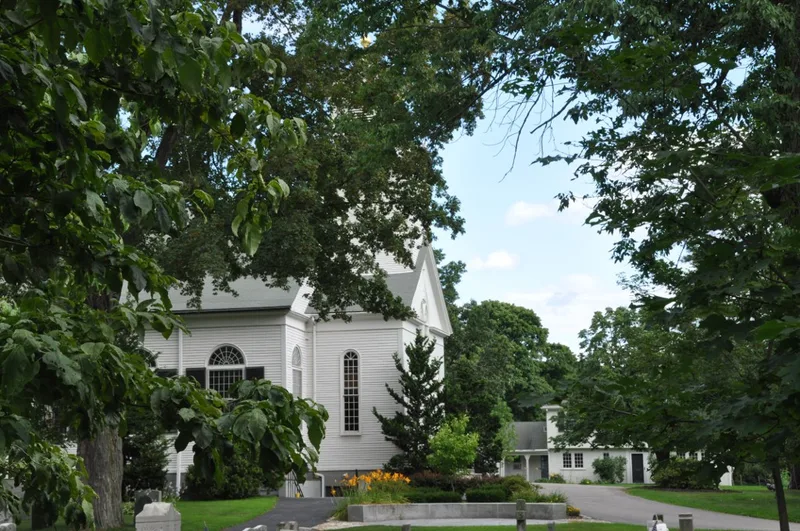
Fifteen properties on a six-acre block in Lower Falls, Newton, make up a surviving fragment of a 19th-century paper-milling village. Bounded by Concord, Grove, Washington and Hagar streets, the district centers on St. Mary's Episcopal Church, built in 1813 and the oldest religious building in Newton, with its burying ground. The c.1755 Baury House is the oldest building in the village. Along Grove Street stand modest Greek Revival houses and cottages built between 1835 and 1855, many for mill workers and mill-related businessmen; Needham builder William Lyon is credited with several. Hose House #6, a brick Renaissance Revival building of 1900, was the last structure added. Highway construction in the 1950s and urban renewal in the 1970s removed most other mill-era buildings, so this block is the only remaining concentration of pre-Civil War architecture in the village. That survival, tied to the paper industry that shaped Lower Falls, is the basis for its recognition.
Significance in brief: The district is described as the last remaining historic-period neighborhood in the former paper-manufacturing village of Lower Falls. It contains mostly Greek Revival houses that retain integrity of workmanship and setting, along with the oldest church and oldest house in the village. The form says it meets criteria A, B and C.
Machine-generated summary. This summary was generated by a language model from the official nomination document and has not been reviewed line by line by an editor. It may contain errors. Check the source document before relying on any detail. Source: nomination document (PDF) · National Archives catalog entry. NRHP reference 86001748, listed September 4, 1986. Summary generated October 2026 (model claude-sonnet-5-5, prompt v1.0-2026-10-29, confidence medium).
Key facts
| Address | Roughly bounded by Hagar, Grove, Washington, and Concord Sts., Newton |
|---|---|
| County | Middlesex County |
| Listed | September 4, 1986 |
| Reference number | 86001748 |
| Resource type | District |
| Period of significance | 1810-1860 |
| Architect / builder | William Lyon (Needham builder); Vaughn Jones (attributed); William P. Morse (Hose House #6 designer) |
| Architectural style | Predominantly Greek Revival, with Federal, High Georgian, Gothic Revival and Renaissance Revival examples |
| Criteria |
|
| Areas of significance | Industry, Architecture |
| Level of significance | State, Local |
| Status (as stated in the nomination) | Present use is primarily residential; general condition is good. Hose House #6 is now a two-family residence. |
| Acreage | 6 |
| Coordinates | 42.32652, -71.25751 (NPS GIS) |
What listing means for this property
This is a historic district. Buildings within its boundary are either contributing (they add to the district's significance) or non-contributing. Owners of contributing income-producing buildings can claim the 20% federal rehabilitation tax credit; homeowners should look at state credits. National Register districts impose no design review by themselves; a local historic district ordinance, if one exists, does (the difference explained).
General information, not legal or tax advice. Rules change; confirm with your State Historic Preservation Office or a qualified adviser.
Sources and further reading
- National Park Service, National Register of Historic Places database (snapshot May 2026), reference 86001748.
- Nomination form (PDF, National Archives) — catalog entry
- Wikipedia article (used for cross-checking only; text not reproduced here)
- Wikidata Q7020305
- This listing as JSON
Last updated October 2026. Found an error? See the editorial policy for how to report it.