Walker Home for Missionary Children
Also known as: See Also:Harding House--Walker Missionary Home

Why it's listed
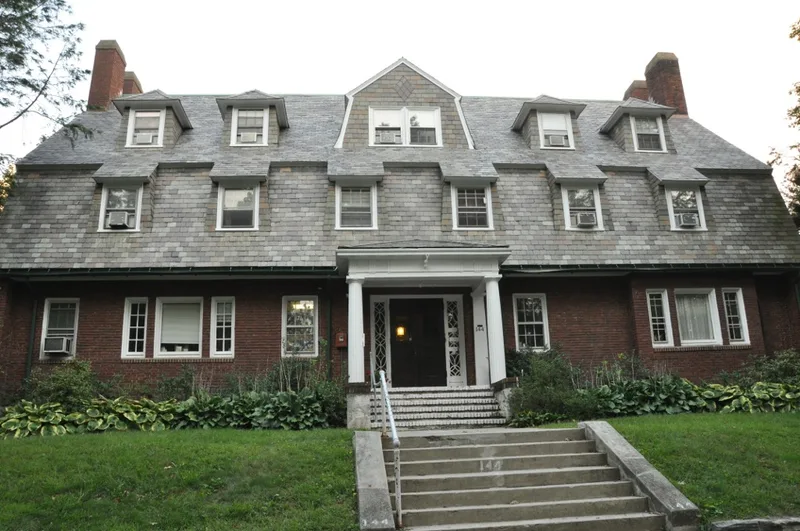
At the corner of Grove and Hancock Streets in Auburndale, a group of eight buildings records the growth of a home for missionary families. Eliza Walker, widow of an American missionary to Turkey, founded the Walker Home for Missionary Children in 1868 and took in children of missionaries stationed around the world, who attended Newton schools. Missionaries on furlough and retired missionary families also stayed there. The main building, Walker House, was designed by Coolidge and Carlson and completed in 1913 after fire destroyed an earlier house. It is a large brick Colonial Revival structure that keeps a domestic character suited to the surrounding neighborhood. The oldest building, Harding East and West, dates from about 1850 and is Italianate. Additional residences, a converted barn, and garages were added mainly in the 1920s and 1930s, with a Cape-style house following in the 1950s. The complex is notable for its long-running missionary association and its role in Auburndale's development.
Significance in brief: The nomination argues the complex is significant for its association with the Walker Home, founded in 1868 to serve missionaries and their children, and for its role in the development of Auburndale. It also includes two buildings of individual architectural merit, Walker House and Harding East and West, and illustrates the growth of an institution serving missionaries.
Machine-generated summary. This summary was generated by a language model from the official nomination document and has not been reviewed line by line by an editor. It may contain errors. Check the source document before relying on any detail. Source: nomination document (PDF) · National Archives catalog entry. NRHP reference 90000047, listed June 4, 1992. Summary generated October 2026 (model claude-sonnet-5-5, prompt v1.0-2026-10-29, confidence medium).
Key facts
| Address | 161--63, 165, 167 Grove St., 136, 138, 144 Hancock St., Newton |
|---|---|
| County | Middlesex County |
| Listed | June 4, 1992 |
| Reference number | 90000047 |
| Resource type | Building |
| Architect / builder | Coolidge and Carlson (Walker House, 1913); Albert Kreider (Eddy House, 1954); Herbert Kellaway (landscaping, late 1930s); Rev. Sewell Harding (Harding East and West) |
| Architectural style | Colonial Revival (Walker, Barton, Howard, Hume Houses); Italianate (Harding East and West); Cape (Eddy House) |
| Criteria |
|
| Areas of significance | Community Planning and Development, Education, Architecture, Religion |
| Level of significance | Local |
| Status (as stated in the nomination) | Described as in good condition, with the Home in continuous operation for more than 120 years and continuing its educational and religious mission. |
| Acreage | 1.5 |
| Coordinates | 42.34147, -71.25084 (NPS GIS) |
What listing means for this property
National Register listing is honorary for a privately owned home: it does not by itself restrict what an owner may do with their own money, and it does not require public access. Restrictions come from local landmark or historic-district ordinances, which are separate (how they differ).
Owner-occupied houses are not eligible for the 20% federal rehabilitation tax credit, which applies to income-producing buildings, but many states offer credits for homeowners. Listing also opens the door to preservation easements and to buying a plaque. Start with what listing means for homeowners, renovating a listed house and selling one.
General information, not legal or tax advice. Rules change; confirm with your State Historic Preservation Office or a qualified adviser.
Sources and further reading
- National Park Service, National Register of Historic Places database (snapshot May 2026), reference 90000047.
- Nomination form (PDF, National Archives) — catalog entry
- Wikipedia article (used for cross-checking only; text not reproduced here)
- Wikidata Q7962274
- This listing as JSON
Last updated October 2026. Found an error? See the editorial policy for how to report it.