Melrose Town Center Historic District

Why it's listed
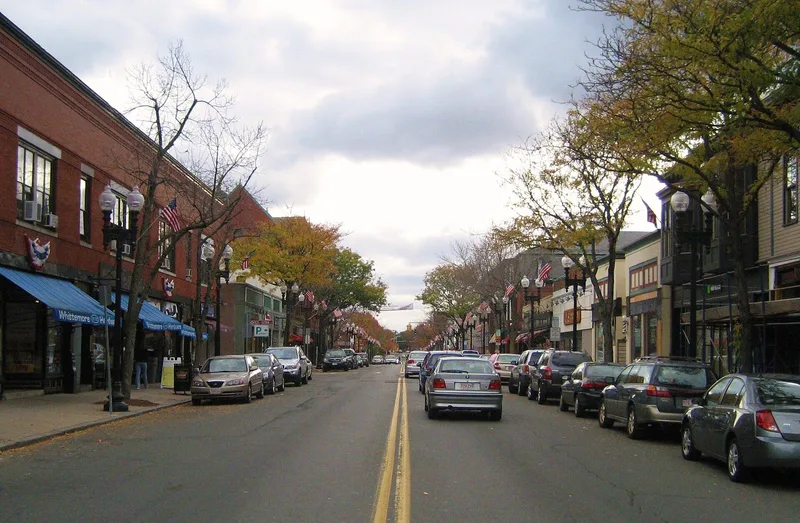
Seven buildings on Main Street in Melrose, Massachusetts, form the town's civic, cultural and religious core. Each stands alone in open space, which sets the group apart from the surrounding low commercial blocks and houses. The group includes City Hall (1874, rebuilt after a 1937 fire), the Fire Station (1895), Memorial Hall (1912, built of granite salvaged from the old Boston Courthouse), the First Baptist Church (1907), the Calvin Coolidge School (1898, originally the high school), the First United Methodist Church (1904) and the Methodist Parsonage (1889). A 1945 War Memorial and an 1885 planting urn are also included. The buildings were constructed between 1870 and 1915, when Melrose grew from a farming community into a railroad suburb of Boston, became a city, and saw its population expand almost fivefold. The district was listed for its role in that growth and for its architectural variety. Its buildings remain in use by government, religious and community groups.
Significance in brief: The nomination argues the district has always been the social, civic and religious center of Melrose and reflects its major period of growth as a Boston suburb between 1870 and 1915. It is also significant as a grouping of architecturally varied buildings that forms the nucleus of the community. It meets criteria A and C.
Machine-generated summary. This summary was generated by a language model from the official nomination document and has not been reviewed line by line by an editor. It may contain errors. Check the source document before relying on any detail. Source: nomination document (PDF) · National Archives catalog entry. NRHP reference 82002744, listed April 1, 1982. Summary generated October 2026 (model claude-sonnet-5-5, prompt v1.0-2026-10-29, confidence high).
Key facts
| Address | Main St., Melrose |
|---|---|
| County | Middlesex County |
| Listed | April 1, 1982 |
| Reference number | 82002744 |
| Resource type | District |
| Period of significance | 1870-1915 |
| Architect / builder | John Stevenson (City Hall, built by Drown & Stafford); Lewis A. Dow (Fire Station, built by Alfred H. Hines); George Newton (Memorial Hall, built by McDonald & Joslin; First Baptist Church, built by Robert Wilson); Tristram Griffin (Coolidge School, built by F.G. Coburn Company); J. William Beal (First United Methodist Church); Joel Brown (Methodist Parsonage) |
| Architectural style | Range of period styles including Second Empire, Romanesque and Classical Revival, neo-classical, Gothic Revival, Renaissance Revival and Queen Anne |
| Criteria |
|
| Areas of significance | Architecture, Performing Arts |
| Level of significance | Local |
| Status (as stated in the nomination) | All buildings are stated to be fully occupied by religious and social groups and local government organizations; the district is in good condition and altered. |
| Acreage | 8 |
| Coordinates | 42.45722, -71.06391 (NPS GIS) |
What listing means for this property
This is a historic district. Buildings within its boundary are either contributing (they add to the district's significance) or non-contributing. Owners of contributing income-producing buildings can claim the 20% federal rehabilitation tax credit; homeowners should look at state credits. National Register districts impose no design review by themselves; a local historic district ordinance, if one exists, does (the difference explained).
General information, not legal or tax advice. Rules change; confirm with your State Historic Preservation Office or a qualified adviser.
Sources and further reading
- National Park Service, National Register of Historic Places database (snapshot May 2026), reference 82002744.
- Nomination form (PDF, National Archives) — catalog entry
- Wikipedia article (used for cross-checking only; text not reproduced here)
- Wikidata Q5303502
- This listing as JSON
Last updated October 2026. Found an error? See the editorial policy for how to report it.