Beebe Estate
Also known as: Foster-Bigelow House

Why it's listed
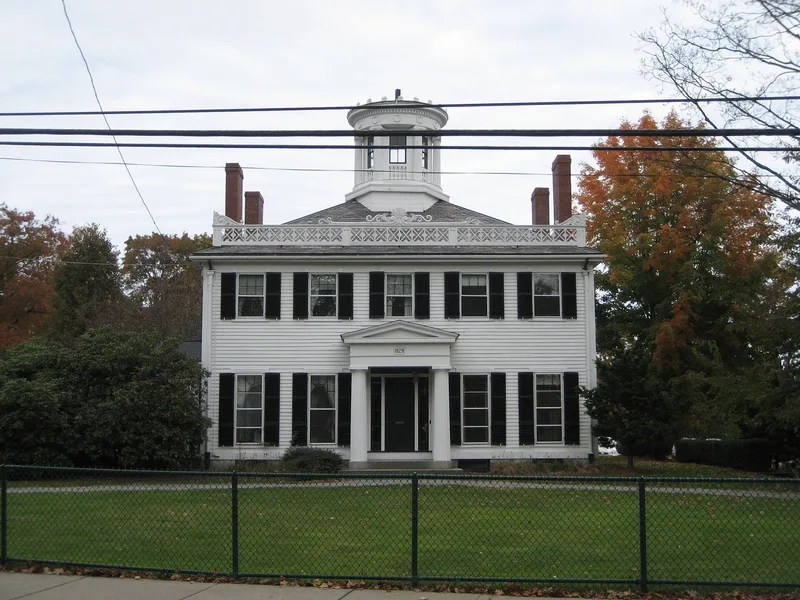
Set well back on about an acre and three-quarters at a major downtown intersection in Melrose, this nearly cubical, clapboarded house dates to 1828. It has two stories, a high hip roof, paired end chimneys, a five-bay facade, and a portico with fluted Doric columns. Its most striking feature is the roofline, with an X-pattern balustrade and a cupola of six fluted Ionic columns modeled on the Choragic Monument of Lysicrates. The form says it is unclear whether the cupola is original. William Foster, a Boston merchant who had smuggled Merino sheep into the United States in 1793, built it as a summer home. Later occupants included William Harlow, a railroad man, and Liberty Bigelow, an express and railway executive. The Melrose Hospital Association was organized in the house in 1893. The Beebe family held it until 1963, when the city took it and made it a school administration building. The grounds may also hold archaeological remains.
Significance in brief: The nomination argues the house is an early achievement in the Greek Revival style, notable for its roofline and an elaborate cupola based on the Choragic Monument of Lysicrates. It was built by a prominent merchant and later occupied by influential businessmen in commerce, industry and transportation. The form also notes archaeological potential on the grounds.
Machine-generated summary. This summary was generated by a language model from the official nomination document and has not been reviewed line by line by an editor. It may contain errors. Check the source document before relying on any detail. Source: nomination document (PDF) · National Archives catalog entry. NRHP reference 81000116, listed May 20, 1981. Summary generated October 2026 (model claude-sonnet-5-5, prompt v1.0-2026-10-29, confidence high).
Key facts
| Address | 235 W. Foster St., Melrose |
|---|---|
| County | Middlesex County |
| Listed | May 20, 1981 |
| Reference number | 81000116 |
| Resource type | Building |
| Period of significance | 1800-1899 |
| Architectural style | Greek Revival |
| Criteria |
|
| Areas of significance | Industry, Commerce, Transportation, Architecture |
| Level of significance | State |
| Status (as stated in the nomination) | Owned by the City of Melrose, in excellent condition and occupied; used as a School Department administration building. |
| Acreage | 1.8 |
| Coordinates | 42.45574, -71.06984 (NPS GIS) |
What listing means for this property
National Register listing is honorary for a privately owned home: it does not by itself restrict what an owner may do with their own money, and it does not require public access. Restrictions come from local landmark or historic-district ordinances, which are separate (how they differ).
Owner-occupied houses are not eligible for the 20% federal rehabilitation tax credit, which applies to income-producing buildings, but many states offer credits for homeowners. Listing also opens the door to preservation easements and to buying a plaque. Start with what listing means for homeowners, renovating a listed house and selling one.
General information, not legal or tax advice. Rules change; confirm with your State Historic Preservation Office or a qualified adviser.
Sources and further reading
- National Park Service, National Register of Historic Places database (snapshot May 2026), reference 81000116.
- Nomination form (PDF, National Archives) — catalog entry
- Wikipedia article (used for cross-checking only; text not reproduced here)
- Wikidata Q4879537
- This listing as JSON
Last updated October 2026. Found an error? See the editorial policy for how to report it.