Holy Trinity Greek Orthodox Church
Also known as: Holy Trinity Hellenic Orthodox Church

Why it's listed
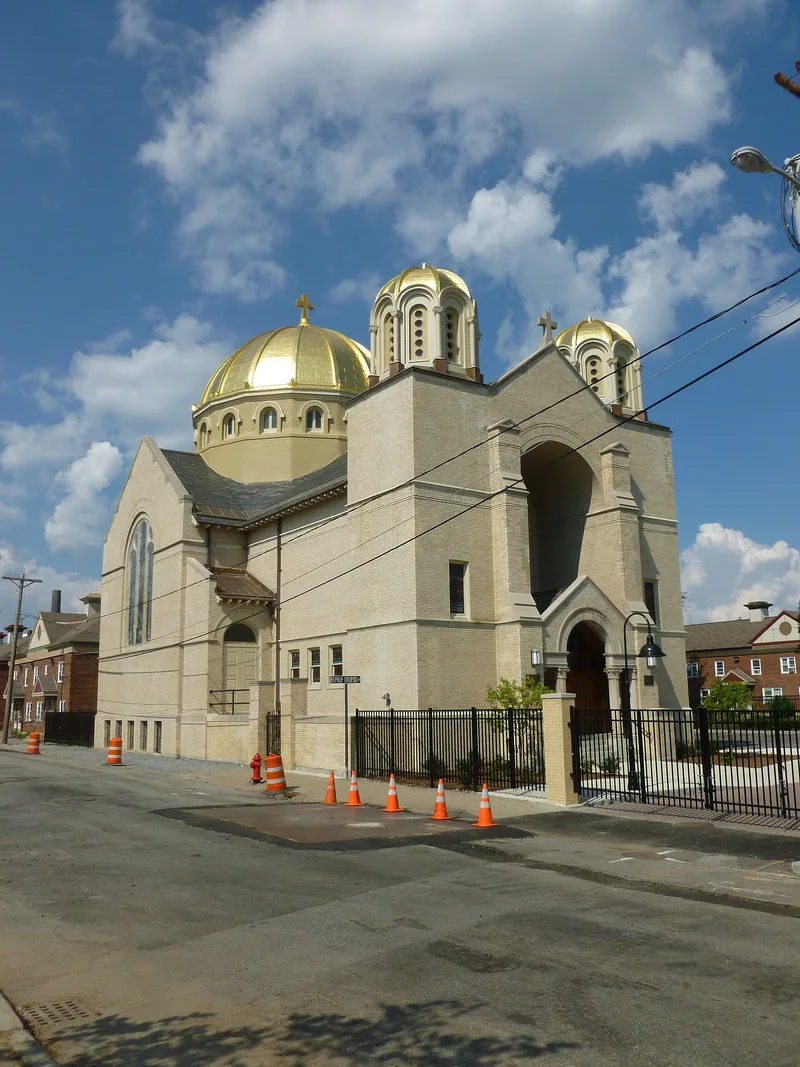
Holy Trinity Greek Orthodox Church sits at the corner of Lewis and Jefferson Streets in Lowell's Acre neighborhood. Construction began in 1906 to designs by local architect Henry L. Rourke, whom parishioners asked to model the building on the Hagia Sophia in Constantinople. The church has a Greek cross plan, yellow brick walls, a gilded dome on a sixteen-sided drum, and a facade of two bell towers joined by an arched bridge. Inside, murals by the German artist G. Rinkelin and an elaborate ikonostasion surround the space beneath the dome. The church is described as the first structure built in the United States to house Greek Orthodox worship. It became the center of Lowell's growing Greek immigrant community, and in 1909 the first Greek school in the area opened in its basement. Parishioners raised funds through donations and family heirlooms, and twice saved the building from seizure by creditors, in 1920 and 1934.
Significance in brief: The nomination argues it was the first structure built to house Greek Orthodox worship in the United States. It also played a central role in developing the Greek community in New England. Architecturally it is a rare example of a Byzantine-derived style.
Machine-generated summary. This summary was generated by a language model from the official nomination document and has not been reviewed line by line by an editor. It may contain errors. Check the source document before relying on any detail. Source: nomination document (PDF) · National Archives catalog entry. NRHP reference 77000181, listed April 13, 1977. Summary generated October 2026 (model claude-sonnet-5-5, prompt v1.0-2026-10-29, confidence high).
Key facts
| Address | Lewis St., Lowell |
|---|---|
| County | Middlesex County |
| Listed | April 13, 1977 |
| Reference number | 77000181 |
| Resource type | Building |
| Period of significance | 1906 |
| Architect / builder | Henry L. Rourke |
| Architectural style | Byzantine-derived |
| Areas of significance | European, Architecture, Religion |
| Level of significance | State |
| Status (as stated in the nomination) | Occupied and in religious use; condition listed as excellent. |
| Acreage | 0.2 |
| Within district | Lowell National Historical Park |
| Coordinates | 42.64561, -71.31679 (NPS GIS) |
What listing means for this property
Religious properties are listed for their architectural or historical significance, not their religious use. Listing is honorary and does not restrict the congregation's use of the building. The federal rehabilitation credit is generally unavailable unless part of the building is income-producing; some state programmes and preservation grants do cover religious buildings. Federal funding or permits trigger Section 106 review.
General information, not legal or tax advice. Rules change; confirm with your State Historic Preservation Office or a qualified adviser.
Sources and further reading
- National Park Service, National Register of Historic Places database (snapshot May 2026), reference 77000181.
- Nomination form (PDF, National Archives) — catalog entry
- Wikipedia article (used for cross-checking only; text not reproduced here)
- Wikidata Q5886742
- This listing as JSON
Last updated October 2026. Found an error? See the editorial policy for how to report it.