High Street Historic District

Why it's listed
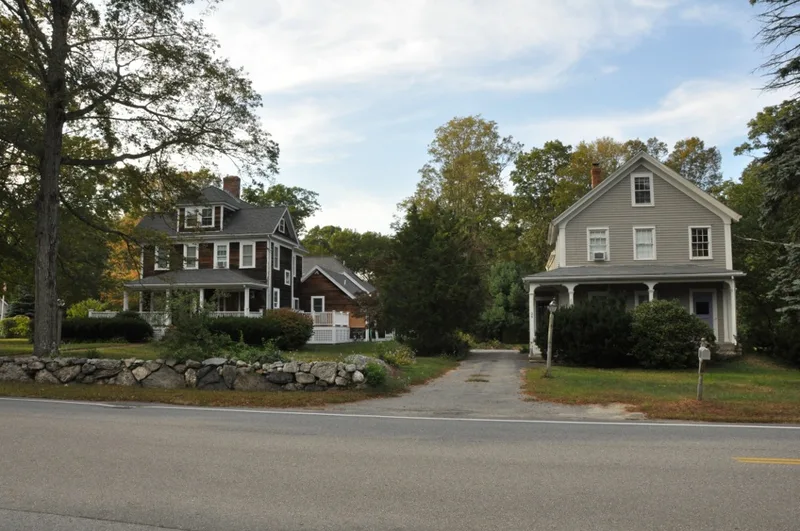
High Street in Wilmington, Massachusetts, is lined with single-family houses that record the town's shift from farmland to suburb. The district covers about sixteen and a half acres and includes seventeen principal houses, three carriage barns and three garages. Six surviving houses were built between about 1851 and 1856, when members of old local families, including the Blanchards, Carters and Harndens, began selling acre lots; the area became known as "New City." These early houses blend Greek Revival, Italianate and Gothic-flavored details, and two were built by housewrights Sylvester Woodward and George Fall. Later houses, dating from about 1880 to the 1950s, add Queen Anne, Colonial Revival, Craftsman bungalow, Neo-Federal and Cape Cod designs. Three houses were moved, two of them to make way for Interstate 93 in the 1950s. The district was recognized for its role in community development and for its architecture, and it may also hold archaeological evidence of a 1665 homestead and of nineteenth-century shoemaking.
Significance in brief: The district shows how the area changed from agricultural land to a mainly residential neighborhood in the mid-19th century, when large landholdings were sold off as house lots and the area earned the name "New City." It also holds a well-preserved collection of Greek Revival, Italianate, Queen Anne, Colonial Revival, Craftsman and Neo-Federal houses. The form notes archaeological potential as well.
Machine-generated summary. This summary was generated by a language model from the official nomination document and has not been reviewed line by line by an editor. It may contain errors. Check the source document before relying on any detail. Source: nomination document (PDF) · National Archives catalog entry. NRHP reference 03001177, listed November 21, 2003. Summary generated October 2026 (model claude-sonnet-5-5, prompt v1.0-2026-10-29, confidence high).
Key facts
| Address | Even nos. 8-72 High St. except 20A and 20R, plus nos. 31, 47, 57 and 67., Wilmington |
|---|---|
| County | Middlesex County |
| Listed | November 21, 2003 |
| Reference number | 03001177 |
| Resource type | District |
| Period of significance | ca. 1851-1953 |
| Architect / builder | Sylvester Woodward; George Fall |
| Architectural style | Greek Revival, Queen Anne, Craftsman |
| Criteria |
|
| Areas of significance | Architecture, Community Planning and Development |
| Level of significance | Local |
| Status (as stated in the nomination) | Houses remain in residential use; many are largely unaltered, though porches, sash and siding have often been changed. |
| Acreage | 16.5 |
| Coordinates | 42.57311, -71.15293 (NPS GIS) |
What listing means for this property
This is a historic district. Buildings within its boundary are either contributing (they add to the district's significance) or non-contributing. Owners of contributing income-producing buildings can claim the 20% federal rehabilitation tax credit; homeowners should look at state credits. National Register districts impose no design review by themselves; a local historic district ordinance, if one exists, does (the difference explained).
General information, not legal or tax advice. Rules change; confirm with your State Historic Preservation Office or a qualified adviser.
Sources and further reading
- National Park Service, National Register of Historic Places database (snapshot May 2026), reference 03001177.
- Nomination form (PDF, National Archives) — catalog entry
- Wikipedia article (used for cross-checking only; text not reproduced here)
- Wikidata Q5757192
- This listing as JSON
Last updated October 2026. Found an error? See the editorial policy for how to report it.