Gowing-Sheldon Historic District

Why it's listed
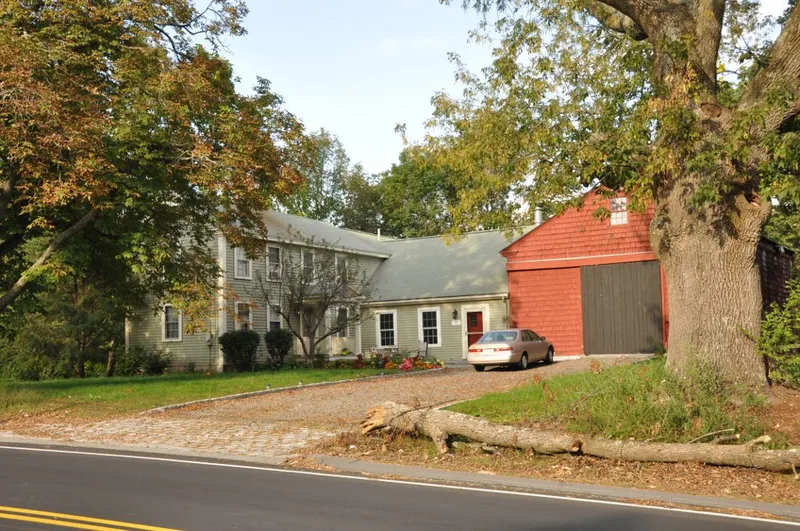
Two farmhouses and their barns face each other across Woburn Street, one of Wilmington's earliest roads, on about 1.22 acres that were once rural. The house at 642 Woburn Street dates to about 1809 and is a Federal style dwelling with a granite block foundation. It is unusually four bays wide and only one room deep, and it keeps its connection to a bank barn. Across the road, the Queen Anne house at 643 was built about 1893 for Lucy and Henry Sheldon Jr. Its carriage barn shows Shingle Style details, such as a curved ventilator and conical hoods, that are rare in Wilmington. The houses were home to related families who settled close to one another along the old road, a pattern also seen in the nearby Buck's Corner district. The district was listed for its architecture and its role in local community development. The form also notes a possibility of surviving Native American and farm-related archaeological remains, including an early shoe shop site.
Significance in brief: The district is significant for architecture and community development. Both houses are well-preserved local examples of their types, and they were built by related Sheldon family members near relatives along an old road. The Queen Anne house's Shingle Style carriage barn is unusual for Wilmington. The form also notes archaeological potential for Native American and historic farm remains.
Machine-generated summary. This summary was generated by a language model from the official nomination document and has not been reviewed line by line by an editor. It may contain errors. Check the source document before relying on any detail. Source: nomination document (PDF) · National Archives catalog entry. NRHP reference 03001176, listed November 21, 2003. Summary generated October 2026 (model claude-sonnet-5-5, prompt v1.0-2026-10-29, confidence high).
Key facts
| Address | 642 and 643 Woburn St., Wilmington |
|---|---|
| County | Middlesex County |
| Listed | November 21, 2003 |
| Reference number | 03001176 |
| Resource type | District |
| Period of significance | ca. 1809 - 1953 |
| Architectural style | Early Republic/Federal; Late Victorian/Queen Anne (with Shingle Style carriage barn) |
| Criteria |
|
| Areas of significance | Architecture, Community Planning and Development |
| Level of significance | Local |
| Status (as stated in the nomination) | Both buildings are in use as single dwellings. They are well preserved, though suburban development has grown up around the district. |
| Acreage | 1.2 |
| Coordinates | 42.54188, -71.14989 (NPS GIS) |
What listing means for this property
This is a historic district. Buildings within its boundary are either contributing (they add to the district's significance) or non-contributing. Owners of contributing income-producing buildings can claim the 20% federal rehabilitation tax credit; homeowners should look at state credits. National Register districts impose no design review by themselves; a local historic district ordinance, if one exists, does (the difference explained).
General information, not legal or tax advice. Rules change; confirm with your State Historic Preservation Office or a qualified adviser.
Sources and further reading
- National Park Service, National Register of Historic Places database (snapshot May 2026), reference 03001176.
- Nomination form (PDF, National Archives) — catalog entry
- Wikipedia article (used for cross-checking only; text not reproduced here)
- Wikidata Q5590084
- This listing as JSON
Last updated October 2026. Found an error? See the editorial policy for how to report it.