Haskell, Charles, House

Why it's listed
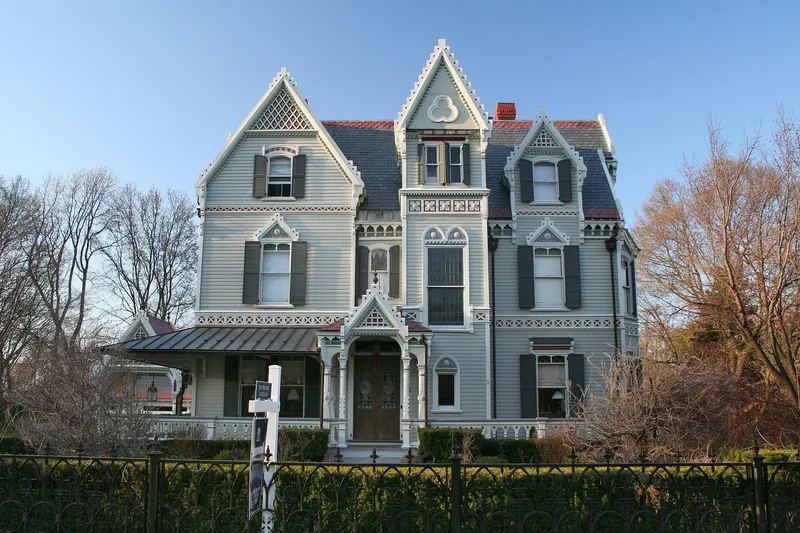
Built in 1879 at 27 Sargent Street in Newton Corner, this clapboard dwelling is one of very few Gothic Revival houses in the neighborhood and is regarded as the finest high-style example in Newton. It rises two and one-half stories on a square plan under a steeply pitched hip roof broken by steep wall dormers. A two-sided porch sits beneath a cantilevered standing-seam roof, and a gabled tower is offset to the right of the entrance. Double doors have stained-glass upper panels and arched transoms. Much of the applied woodwork, produced with the newly invented scroll saw, draws on medieval ideas, including pointed arches in the porch balusters and a trefoil design in the facade gable. An elaborate porte-cochere adds to the effect. The lot was once part of George C. Lord's large estate, sold off after 1875 near fashionable Kenrick Park. Charles Haskell, a Boston leather dealer, was among the wealthy buyers. The house remains a dwelling in excellent condition and unaltered.
Significance in brief: The house is a rare example of the Gothic Revival style in Newton Corner and is described as the city's finest high-styled version of that style. It displays abundant applied wooden trim made possible by the scroll saw. It also reflects the subdivision of the George C. Lord estate for wealthy Boston professionals and merchants.
Machine-generated summary. This summary was generated by a language model from the official nomination document and has not been reviewed line by line by an editor. It may contain errors. Check the source document before relying on any detail. Source: nomination document (PDF) · National Archives catalog entry. NRHP reference 86001812, listed September 4, 1986. Summary generated October 2026 (model claude-sonnet-5-5, prompt v1.0-2026-10-29, confidence medium).
Key facts
| Address | 27 Sargent St., Newton |
|---|---|
| County | Middlesex County |
| Listed | September 4, 1986 |
| Reference number | 86001812 |
| Resource type | Building |
| Architectural style | High Victorian Gothic (Gothic Revival) |
| Criteria |
|
| Areas of significance | Architecture |
| Level of significance | State, Local |
| Status (as stated in the nomination) | Condition listed as excellent, with no major alterations and no outbuildings; present use is a dwelling, as was the original use. |
| Acreage | 0.7 |
| Coordinates | 42.34711, -71.18232 (NPS GIS) |
What listing means for this property
National Register listing is honorary for a privately owned home: it does not by itself restrict what an owner may do with their own money, and it does not require public access. Restrictions come from local landmark or historic-district ordinances, which are separate (how they differ).
Owner-occupied houses are not eligible for the 20% federal rehabilitation tax credit, which applies to income-producing buildings, but many states offer credits for homeowners. Listing also opens the door to preservation easements and to buying a plaque. Start with what listing means for homeowners, renovating a listed house and selling one.
General information, not legal or tax advice. Rules change; confirm with your State Historic Preservation Office or a qualified adviser.
Sources and further reading
- National Park Service, National Register of Historic Places database (snapshot May 2026), reference 86001812.
- Nomination form (PDF, National Archives) — catalog entry
- Wikipedia article (used for cross-checking only; text not reproduced here)
- Wikidata Q5078831
- This listing as JSON
Last updated October 2026. Found an error? See the editorial policy for how to report it.