Durant, Capt. Edward, House
Also known as: Kenrick House; Kendrick House; Durant-Kenrick House

Why it's listed
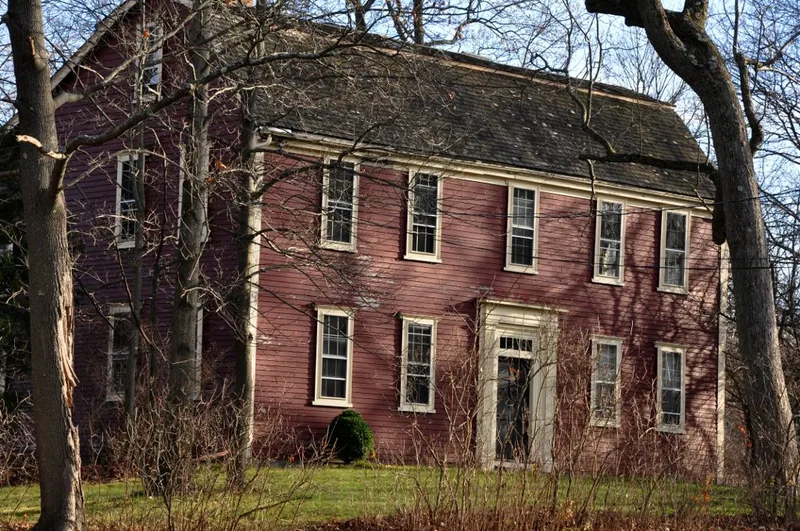
Built soon after Edward Durant bought 91 acres in Newton in 1732, this two-story clapboard house on Waverley Avenue has a gambrel roof, two chimneys and a symmetrical five-bay facade. Durant, a Boston smith called "Captain" in public records, died in 1740. His son Edward later housed the town grammar school there and took part in pre-Revolutionary activities, including chairing the Colony's Committee of Correspondence. The Kenrick family, who ran a noted nursery from 1790, owned the house until 1903, after which a Durant bought it back. The house follows an early four-room plan with a central passage. The north front room keeps its 1730s woodwork, window seats and shutters. Four rooms have stencilled floors from about 1790, and part of the original roof survives. It is listed as one of Newton's oldest structures and as the home of a prominent family.
Significance in brief: The house is significant as the home of the wealthy and prominent Edward Durant and as one of the oldest surviving structures in Newton. Its architectural interest lies in its survival, its early four-room plan with central passage, stencil-decorated floors of about 1790, rare window seats and shutters, and a surviving section of original roof.
Machine-generated summary. This summary was generated by a language model from the official nomination document and has not been reviewed line by line by an editor. It may contain errors. Check the source document before relying on any detail. Source: nomination document (PDF) · National Archives catalog entry. NRHP reference 76000267, listed May 13, 1976. Summary generated October 2026 (model claude-sonnet-5-5, prompt v1.0-2026-10-29, confidence high).
Key facts
| Address | 286 Waverly Ave., Newton |
|---|---|
| County | Middlesex County |
| Listed | May 13, 1976 |
| Reference number | 76000267 |
| Resource type | Building |
| Period of significance | 1700-1799 and 1800-1899 (specific date c. 1732) |
| Areas of significance | Military, Politics/Government, Architecture |
| Level of significance | Local |
| Status (as stated in the nomination) | Listed as occupied, in private ownership and used as a private residence; maintained by the Edward Durant Homestead Trust. Condition is described as good and altered. |
| Acreage | 1.2 |
| Coordinates | 42.34625, -71.18059 (NPS GIS) |
What listing means for this property
National Register listing is honorary for a privately owned home: it does not by itself restrict what an owner may do with their own money, and it does not require public access. Restrictions come from local landmark or historic-district ordinances, which are separate (how they differ).
Owner-occupied houses are not eligible for the 20% federal rehabilitation tax credit, which applies to income-producing buildings, but many states offer credits for homeowners. Listing also opens the door to preservation easements and to buying a plaque. Start with what listing means for homeowners, renovating a listed house and selling one.
General information, not legal or tax advice. Rules change; confirm with your State Historic Preservation Office or a qualified adviser.
Sources and further reading
- National Park Service, National Register of Historic Places database (snapshot May 2026), reference 76000267.
- Nomination form (PDF, National Archives) — catalog entry
- Wikipedia article (used for cross-checking only; text not reproduced here)
- Wikidata Q5036417
- This listing as JSON
Last updated October 2026. Found an error? See the editorial policy for how to report it.