Groton Inn
Also known as: The Inn at Groton

Why it's listed
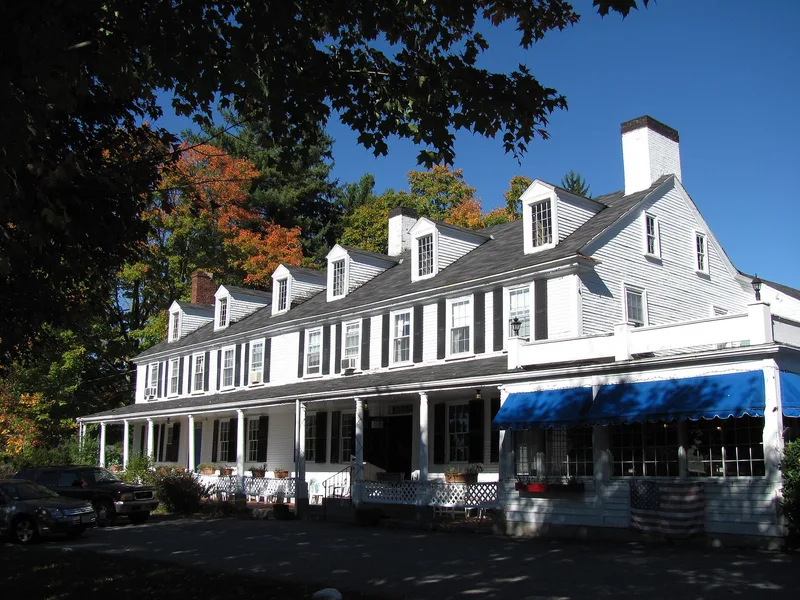
Groton Inn occupies a gently sloping lot on Main Street in the center of Groton, Massachusetts, and anchors the town's local historic district. Though it looks like a single white clapboard building, it combines three older structures. The first was a half-house probably built in 1723 by Samuel Parker and enlarged in 1761 for Reverend Samuel Dana. A second building, probably the town's 1714 meeting house, was joined to the rear in the 1790s. A third, possibly the 1678 Richardson Tavern, was added in 1840 along with the porch. Use as an inn began around 1780 under Captain Jonathan Keep. The building later hosted St. Paul's Masonic Lodge from 1797 to 1847, served as a stagecoach stop at a junction of routes, and held town meetings, including the 1846 Railroad Meeting. Its register carried the names of presidents and authors. Outbuildings include a barn, an annex and a 1914 brick garage.
Significance in brief: The nomination cites its long history as an inn and its prominence as an architectural element in Groton's center. It is of particular interest because it combines three of the town's historic structures. It also served as a stagecoach stop, a Masonic meeting place and a gathering site for town affairs.
Machine-generated summary. This summary was generated by a language model from the official nomination document and has not been reviewed line by line by an editor. It may contain errors. Check the source document before relying on any detail. Source: nomination document (PDF) · National Archives catalog entry. NRHP reference 76000241, listed August 3, 1976. Summary generated October 2026 (model claude-sonnet-5-5, prompt v1.0-2026-10-29, confidence medium).
Key facts
| Address | Main St., Groton |
|---|---|
| County | Middlesex County |
| Listed | August 3, 1976 |
| Reference number | 76000241 |
| Resource type | Building |
| Period of significance | 1800-1899 |
| Areas of significance | Architecture, Social History |
| Level of significance | Local |
| Status (as stated in the nomination) | Form lists the property as occupied and in fair, altered condition, privately owned and commercial. A cover letter calls it endangered, and press clippings describe plans to re-open it under new owners. |
| Acreage | 8.3 |
| Coordinates | 42.60693, -71.56806 (NPS GIS) |
What listing means for this property
For an income-producing building, listing (individually or as a contributing building in a district) is the gateway to the 20% federal rehabilitation tax credit on qualified rehabilitation costs, often stackable with state credits. Work claiming the credit must follow the Secretary of the Interior's Standards and be approved in advance.
Listing does not restrict a private owner acting without federal money or permits; where federal funding or licensing is involved, Section 106 review applies.
General information, not legal or tax advice. Rules change; confirm with your State Historic Preservation Office or a qualified adviser.
Sources and further reading
- National Park Service, National Register of Historic Places database (snapshot May 2026), reference 76000241.
- Nomination form (PDF, National Archives) — catalog entry
- Wikipedia article (used for cross-checking only; text not reproduced here)
- Wikidata Q14715497
- This listing as JSON
Last updated October 2026. Found an error? See the editorial policy for how to report it.