Boutwell, Gov. George S., House
Also known as: Groton Historical Society

Why it's listed
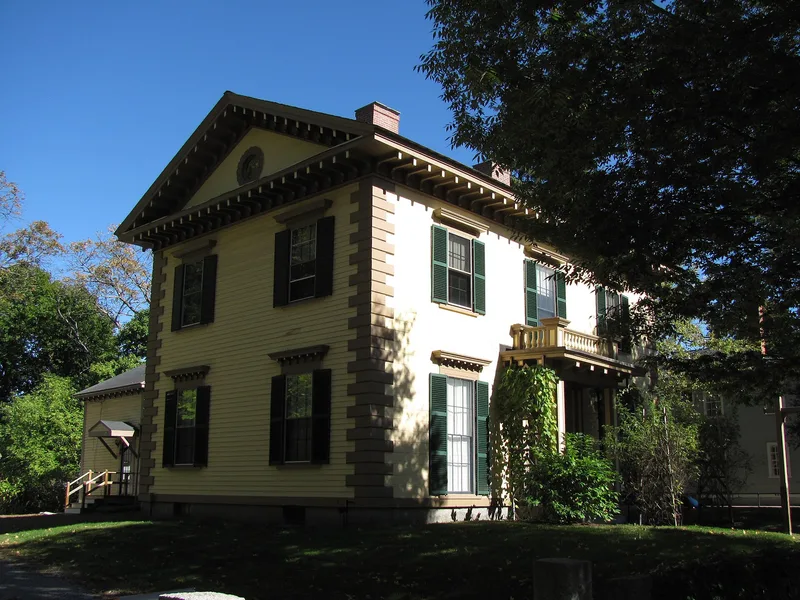
Built in 1851 on Main Street in Groton's town center, this 2½-story clapboard house blends Greek Revival and Italianate design. Its features include quoined corners, a deep bracketed cornice, a canopy over the center entry, and a rear wing expanded in the late 19th century. Inside, a broad center hall with a curving staircase, marble mantels, paneled blinds and a preserved brick kitchen chimney with bake oven survive largely unchanged since the owner's death in 1905. George S. Boutwell built the house in the year he became Massachusetts governor. He later served in Congress, helped write the 14th and 15th amendments, managed the impeachment of President Andrew Johnson, and became Secretary of the Treasury under Ulysses S. Grant, who visited the house in 1869. The property also includes a granite retaining wall, hitching post and mounting block, and a 1960s storage building. The Groton Historical Society now operates it as a museum.
Significance in brief: The house was the home of Gov. George S. Boutwell, who served as Massachusetts governor, U.S. Congressman, Secretary of the Treasury under President Grant, and U.S. Senator. It retains a largely unaltered mid-19th-century interior, including its kitchen chimney with bake oven and set kettles. The form also notes a high potential for historic archaeological resources on the lot.
Machine-generated summary. This summary was generated by a language model from the official nomination document and has not been reviewed line by line by an editor. It may contain errors. Check the source document before relying on any detail. Source: nomination document (PDF) · National Archives catalog entry. NRHP reference 04001431, listed January 5, 2005. Summary generated October 2026 (model claude-sonnet-5-5, prompt v1.0-2026-10-29, confidence medium).
Key facts
| Address | 172 Main St., Groton |
|---|---|
| County | Middlesex County |
| Listed | January 5, 2005 |
| Reference number | 04001431 |
| Resource type | Building |
| Architectural style | Mid-19th Century: Greek Revival; Mid-19th Century: Italianate |
| Areas of significance | Architecture, Communications, Politics/Government, Education |
| Level of significance | State, Local |
| Status (as stated in the nomination) | Used as a museum by the Groton Historical Society, with two tenant apartments in the rear wing created in 1939-40. |
| Acreage | 0.9 |
| Coordinates | 42.60830, -71.57092 (NPS GIS) |
What listing means for this property
National Register listing is honorary for a privately owned home: it does not by itself restrict what an owner may do with their own money, and it does not require public access. Restrictions come from local landmark or historic-district ordinances, which are separate (how they differ).
Owner-occupied houses are not eligible for the 20% federal rehabilitation tax credit, which applies to income-producing buildings, but many states offer credits for homeowners. Listing also opens the door to preservation easements and to buying a plaque. Start with what listing means for homeowners, renovating a listed house and selling one.
General information, not legal or tax advice. Rules change; confirm with your State Historic Preservation Office or a qualified adviser.
Sources and further reading
- National Park Service, National Register of Historic Places database (snapshot May 2026), reference 04001431.
- Nomination form (PDF, National Archives) — catalog entry
- Wikipedia article (used for cross-checking only; text not reproduced here)
- Wikidata Q5588521
- This listing as JSON
Last updated October 2026. Found an error? See the editorial policy for how to report it.