Blake and Knowles Steam Pump Company National Register District
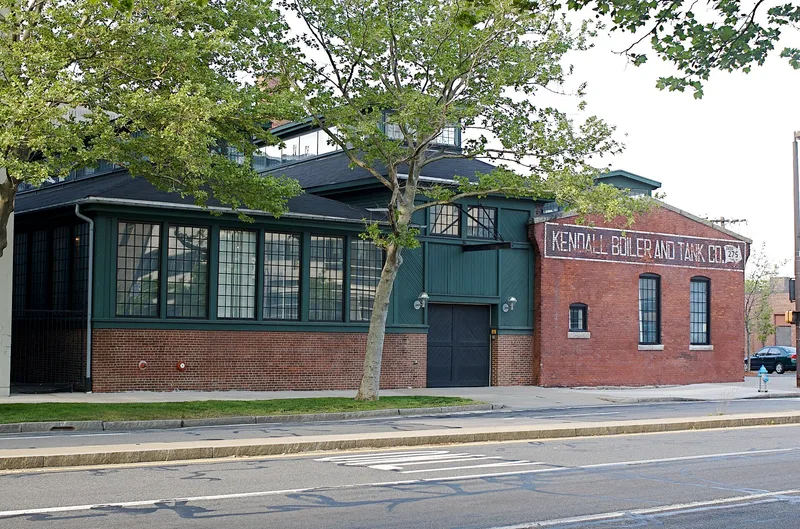

Why it's listed
This one-block industrial district in East Cambridge preserves the last intact section of the Blake & Knowles Steam Pump Company plant. Six buildings, built between 1889 and 1918, occupy about 2.4 acres between Third, Rogers, Fifth and Binney Streets. They include the 400-foot-long #1 Machine Shop, the formally detailed Office Headhouse, a Smith Shop and Brass Foundry, the 1903 Erecting and Assembling Building, and two large machine shops from 1917 and 1918. The latter were the complex's first concrete buildings and used steel sash windows. The company began with George F. Blake's pump for clay pits in brickyards, and merged with the Knowles pump business in 1897. At its peak the plant covered six acres, but nearby buildings have been replaced or heavily altered. The surviving block keeps its massing, scale and brick and concrete materials, despite window replacements and a few additions. It was recognized for its role in local industry and for its representative industrial architecture.
Significance in brief: The district is the only intact block of the former Blake & Knowles pump complex, which once covered about six acres. It is significant for its industrial history and for its architecture, with buildings of consistent scale, massing and materials from two building periods, 1889-1903 and 1917-1918. The company grew out of George F. Blake's pump inventions and a 1897 merger with the Knowles pump business.
Machine-generated summary. This summary was generated by a language model from the official nomination document and has not been reviewed line by line by an editor. It may contain errors. Check the source document before relying on any detail. Source: nomination document (PDF) · National Archives catalog entry. NRHP reference 97000561, listed June 13, 1997. Summary generated October 2026 (model claude-sonnet-5-5, prompt v1.0-2026-10-29, confidence high).
Key facts
| Address | Bounded by Third, Binney, Fifth, and Rogers Sts., Cambridge |
|---|---|
| County | Middlesex County |
| Listed | June 13, 1997 |
| Reference number | 97000561 |
| Resource type | District |
| Period of significance | 1889-1946 |
| Architect / builder | Aberthaw Construction Co.; Flint Building Construction Co. of Palmer, MA (builder of the #1 Machine Shop); L. H. Gager of Palmer, MA designed the Main Foundry, which lies outside the district |
| Architectural style | Late Victorian: Panel Brick; Late 19th and Early 20th Century American Movements |
| Criteria |
|
| Areas of significance | Industry, Architecture |
| Level of significance | Local |
| Status (as stated in the nomination) | Properties are in fair condition with many minor alterations; the buildings have continued in manufacturing and combined office/industrial use, and a developer planned a rehabilitation of the block. |
| Acreage | 2.4 |
| Coordinates | 42.36625, -71.08341 (NPS GIS) |
What listing means for this property
This is a historic district. Buildings within its boundary are either contributing (they add to the district's significance) or non-contributing. Owners of contributing income-producing buildings can claim the 20% federal rehabilitation tax credit; homeowners should look at state credits. National Register districts impose no design review by themselves; a local historic district ordinance, if one exists, does (the difference explained).
General information, not legal or tax advice. Rules change; confirm with your State Historic Preservation Office or a qualified adviser.
Sources and further reading
- National Park Service, National Register of Historic Places database (snapshot May 2026), reference 97000561.
- Nomination form (PDF, National Archives) — catalog entry
- Wikipedia article (used for cross-checking only; text not reproduced here)
- Wikidata Q4924516
- This listing as JSON
Last updated October 2026. Found an error? See the editorial policy for how to report it.