Fort Hill Historic District

Why it's listed
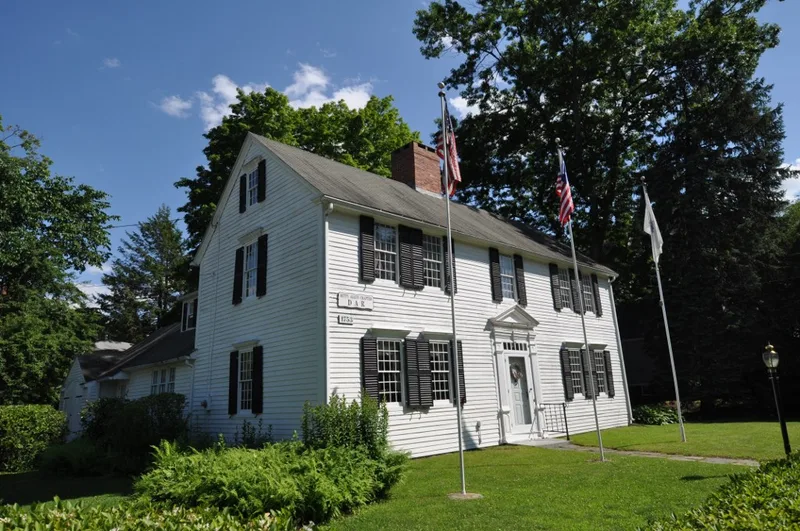
Six clapboard houses line South Street in southeast Northampton, Massachusetts, forming a compact residential enclave on about 2.2 acres between the Mill River and a wide marsh. The earliest is the Charles Clapp House of 1753, followed by homes of 1792, 1797, and about 1800, with two early Greek Revival houses from about 1830. A multi-car garage from the twentieth century is the only noncontributing building. The houses were built by or for early settler families, including the Clapp, Bartlett, and Strong families, and have been lived in continuously for over two centuries. The area takes its name from an Indian fortification on Fort Hill. The district was listed because it records the early settlement of Northampton and because it is the town's only surviving contiguous group of eighteenth and early nineteenth-century houses. Architects are unknown; local builders likely used pattern books or accepted conventions, producing cohesive Colonial, Federal, and Greek Revival buildings.
Significance in brief: The nomination argues the district is significant for its association with the early settlement of Northampton, since the houses were built by or for early settlers and their descendants. It also cites architectural value as the only surviving contiguous group of 18th and early 19th-century homes in the town, with good examples of Colonial, Federal and early Greek Revival styles.
Machine-generated summary. This summary was generated by a language model from the official nomination document and has not been reviewed line by line by an editor. It may contain errors. Check the source document before relying on any detail. Source: nomination document (PDF) · National Archives catalog entry. NRHP reference 88000910, listed April 7, 1989. Summary generated October 2026 (model claude-sonnet-5-5, prompt v1.0-2026-10-29, confidence high).
Key facts
| Address | Roughly South St. from Lyman to Monroe, Northampton |
|---|---|
| County | Hampshire County |
| Listed | April 7, 1989 |
| Reference number | 88000910 |
| Resource type | District |
| Period of significance | 1753-1938 |
| Architectural style | Colonial; Early Republic/Federal; Mid-19th Century/Greek Revival |
| Criteria |
|
| Areas of significance | Architecture |
| Level of significance | Local |
| Status (as stated in the nomination) | Houses are described as in very good condition and continuously occupied as residences for over two centuries; one serves as a chapter headquarters of the D.A.R. |
| Acreage | 2.2 |
| Coordinates | 42.31216, -72.63294 (NPS GIS) |
What listing means for this property
This is a historic district. Buildings within its boundary are either contributing (they add to the district's significance) or non-contributing. Owners of contributing income-producing buildings can claim the 20% federal rehabilitation tax credit; homeowners should look at state credits. National Register districts impose no design review by themselves; a local historic district ordinance, if one exists, does (the difference explained).
General information, not legal or tax advice. Rules change; confirm with your State Historic Preservation Office or a qualified adviser.
Sources and further reading
- National Park Service, National Register of Historic Places database (snapshot May 2026), reference 88000910.
- Nomination form (PDF, National Archives) — catalog entry
- Wikipedia article (used for cross-checking only; text not reproduced here)
- Wikidata Q5471339
- This listing as JSON
Last updated October 2026. Found an error? See the editorial policy for how to report it.