Downtown Springfield Railroad District

Why it's listed
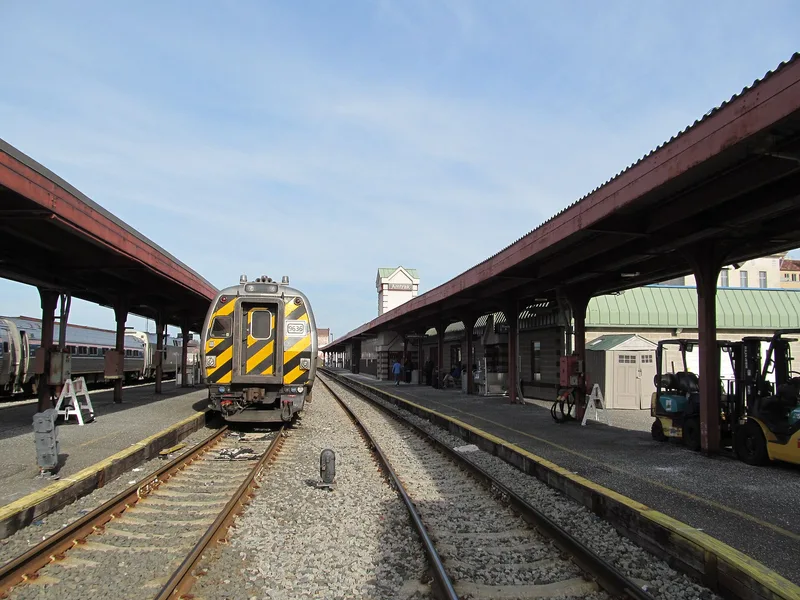
Downtown Springfield's Railroad District groups eleven buildings and structures tied to the Boston & Albany Railroad, covering about 18.6 acres near the tracks between Main, Lyman, Spring and Frank B. Murray Streets. Most are brick. The district includes the long freight house, a row of multi-story warehouses on upper Lyman Street, the Terminal Building, the Hotel Charles, Union Station, and the granite Railroad Arch and retaining wall. The arch carried the tracks over Main Street in 1889, ending a congested grade crossing, and followed a design proposed by H. H. Richardson and completed by his successor firm. Union Station was built in 1925-26 and replaced earlier stations. Warehouses housed cotton waste dealers, grocery wholesalers and commission merchants who needed rail access. Springfield, the junction of major rail lines, became known as the crossroads of New England, and this district is the city's clearest surviving record of how railroads shaped its commerce and growth.
Significance in brief: The district is described as the city's most direct representation of the impact of railroads on Springfield, which became the junction of major north-south and east-west rail lines. Rail access gave the city an economic advantage in late 19th century industrial and commercial growth. The nomination cites criteria A and C, noting the area's integrity and its mostly brick vernacular warehouses, station, hotel and railroad structures.
Machine-generated summary. This summary was generated by a language model from the official nomination document and has not been reviewed line by line by an editor. It may contain errors. Check the source document before relying on any detail. Source: nomination document (PDF) · National Archives catalog entry. NRHP reference 83000745, listed May 27, 1983. Summary generated October 2026 (model claude-sonnet-5-5, prompt v1.0-2026-10-29, confidence medium).
Key facts
| Address | Roughly bounded by Lyman, Main, Murray, and Spring Sts., Springfield |
|---|---|
| County | Hampden County |
| Listed | May 27, 1983 |
| Reference number | 83000745 |
| Resource type | District |
| Period of significance | 1875-1925 |
| Architect / builder | Feldheimer and Wagner (Union Station); F. B. Freeman (baggage, mail and express building); F. M. Davison (freight house office); Albert Lavalle (Hotel Charles); E. C. and G. C. Gardner (Terminal Building); H. H. Richardson and Shepley, Rutan & Coolidge (Railroad Arch) |
| Architectural style | Variety of vernacular late 19th and early 20th century styles; modified classical (Union Station); French Renaissance (Hotel Charles) |
| Criteria |
|
| Areas of significance | Transportation, Architecture |
| Level of significance | Local |
| Acreage | 18.6 |
| Coordinates | 42.10860, -72.58981 (NPS GIS) |
What listing means for this property
This is a historic district. Buildings within its boundary are either contributing (they add to the district's significance) or non-contributing. Owners of contributing income-producing buildings can claim the 20% federal rehabilitation tax credit; homeowners should look at state credits. National Register districts impose no design review by themselves; a local historic district ordinance, if one exists, does (the difference explained).
General information, not legal or tax advice. Rules change; confirm with your State Historic Preservation Office or a qualified adviser.
Sources and further reading
- National Park Service, National Register of Historic Places database (snapshot May 2026), reference 83000745.
- Nomination form (PDF, National Archives) — catalog entry
- Wikipedia article (used for cross-checking only; text not reproduced here)
- Wikidata Q5303586
- This listing as JSON
Last updated October 2026. Found an error? See the editorial policy for how to report it.